
GEMA VS. THE AI TITANS (SUNO.AI & OPENAI): AI MUSIC IN COURT – AND WHY THIS IS JUST THE BEGINNING
2026-03-10
Author: Jens Henneberg
As of: 2026-03-11 - 09:47
Courtroom 270, Munich Palace of Justice, March 9, 2026. Music is playing, but no one is dancing. Six songs, two worlds: first the original, then the machine’s derivative. Forever Young, Atemlos, Mambo No. 5. Judge Elke Schwager listens. The same woman who handed down the landmark OpenAI ruling four months earlier now faces the question: Did Suno violate the rights of the composers and lyricists? Or is Suno’s AI training and music generation legal?
On March 9, 2026, the Munich I Regional Court heard GEMA’s lawsuit against Suno (Ref. 42 O 763/25). This is the first time that a German court has been confronted with the question of whether an AI music generator and/or its operators and/or users infringe the rights of composers and songwriters. At the same time, billion-dollar lawsuits are underway in the US, while the major labels – the three market-dominating music companies Universal, Sony, and Warner – are already reaching settlements (out-of-court settlements) and, incidentally, perfecting the “launch, train, settle” playbook – the pattern in which AI companies first launch the product on the market, then train it without a license, and finally settle with the big players (see section 4.2). And in Germany? Two courts disagree on the same legal issue.
This article shows you what is at stake legally in Munich, which arguments from the OpenAI ruling and the LAION case law are dangerous for Suno – and why Section 44b of the German Copyright Act (UrhG) is the central breaking point: the section on which two German courts have come to opposite conclusions.
1. GEMA VS. SUNO: THE PROCEEDINGS BEFORE THE MUNICH REGIONAL COURT I
On January 21, 2025, GEMA – a collecting society, i.e., an organization that manages the copyrights of its members (composers, lyricists) and collects license fees on their behalf – became the first European collecting society to file a lawsuit against an AI music generator (GEMA, press release dated January 21, 2025, gema.de). Defendant: Suno Inc., a US company based in Cambridge, Massachusetts. Valuation: $2.45 billion. Users: around 100 million (BBC, November 25, 2025, bbc.com). File number: 42 O 763/25.
The case is being heard by the 42nd Civil Chamber of the Munich I Regional Court. The same chamber that handed down the GEMA vs. OpenAI ruling four months earlier.
This is no coincidence.
And that is precisely what will become a problem.
WHAT GEMA IS COMPLAINING ABOUT
The lawsuit is based on two grounds for claims:
- § 16 UrhG (right of reproduction): Suno trained its model on the GEMA repertoire. The imprinting (i.e., “burning in”) copyright-protected works into model parameters—the billions of numerical values in which an AI model stores what it has learned from the training data—constitutes reproduction. The same court already ruled this way in the OpenAI ruling (LG Munich I, ruling of November 11, 2025—42 O 14139/24, GRUR-RS 2025, 30204, paras. 181–185).
- § 19a UrhG (right of public disclosure): The outputs generated by Suno are “confusingly similar” to the originals (according to the GEMA press release). The provision of these outputs via suno.com constitutes public disclosure.
THE WORKS CONCERNED
Six songs are the subject of the dispute (GEMA, press release dated March 9, 2026, gema.de):
| Song | Author/Performer |
|---|---|
| “Forever Young” | Alphaville (Marian Gold, Frank Mertens, Rolf Ellmer) |
| “Atemlos durch die Nacht” | Kristina Bach |
| “Mambo No. 5” | Lou Bega / Perez Prado |
| “Daddy Cool” | Frank Farian / Boney M |
| “Rasputin” | Frank Farian / Boney M |
| “Big in Japan” | Alphaville (Marian Gold, Frank Mertens, Bernhard Lloyd) |
(Why isn’t Helene Fischer listed for “Atemlos durch die Nacht”? Because she only sings the song. It was composed and written by Kristina Bach. GEMA exclusively represents authors—i.e., composers and lyricists—not the performing artists. When it comes to the unauthorized reproduction of the work through AI training, the author is decisive, not the pop star on stage.)
GEMA has presented audio samples that are intended to prove that Suno’s outputs are “confusingly similar” to the originals in terms of music and lyrics. This is supported by an expert opinion from musicologist Julia Blum and – and this is the strategic move – by Suno’s own statement in the US proceedings that the model was trained on “tens of millions” of publicly available recordings (RIAA, press release dated June 24, 2024, riaa.com).
Just so there are no misunderstandings: I’m not saying this from an ivory tower. I make music myself. I have been since I was about 17 or 18. That’s a good 30 years now. I work with everything the scene has to offer. Including SUNO.AI. See also my article on this:
But also with DAWs such as Cubase 15 Pro, Ableton Live 12, FL Studio and various VSTs. I play the keyboard myself and used to be a freestyle rapper. In 1992, I was on stage with Fettes Brot at the Battle of the Year in Celle. At that time, Fettes Brot was still a school band on the Hamburg scene (their first album, “Auf einem Auge blöd” was released in 1995).
That doesn’t make me Eminem or Mozart. But it’s enough to give me a decent feel for music and, above all, to know how this world ticks.
And I’m more of a hybrid musician. In my latest tracks, I’m turning the human parameters back up. I’ll probably sing all the vocals myself on my next rap songs. If necessary, I’ll just pitch the orc-like voice a little.
What strikes me again and again, and this brings me back to my previous point: when I search for public domain music, the internet in this country regularly spits out songs that even my grandmother – who is probably playing cards with Saint Peter by now – would have said: “Boy, turn off that ghastly music, or my dentures will fall out.”
Such a model cannot have been trained exclusively on license-free music.
But back to the theatricality of the trial.
THE MOTION FOR RECUSAL
The first oral hearing was scheduled for January 26, 2026. Suno first filed a motion for recusal against the presiding judge. The motion was denied, but the appeal period was still open – so the date was postponed to March 9, 2026 (Bavarian State Ministry of Justice, press release dated January 20, 2026, justiz.bayern.de). 9:00 a.m., Courtroom 270, Munich Palace of Justice.
(The hearing took place on March 9, 2026 – see update under section 4.5. Judgment on June 12, 2026).
Why a motion for recusal? The court has already confirmed GEMA’s position in the OpenAI case. The strategy is transparent: if you can’t change the judgment, try to change the judge.
Didn’t work.
RIGHT TO SUE AND GEMA ARCHITECTURE
GEMA is authorized to exercise the rights of its members under Section 2 of the Collecting Societies Act (VGG). The authorization agreement was amended at the general meeting on May 15–17, 2022, and since then has expressly included the assertion of claims in connection with AI training. Since 2024, GEMA has also declared a reservation of use on its website in accordance with Section 44b (3) of the German Copyright Act (UrhG) – the so-called opt-out, a machine-readable reservation with which rights holders expressly object to AI training on their works – vis-à-vis commercial AI providers.
GEMA is not only the plaintiff in this case. In September 2024, it presented the world’s first AI licensing model for a collecting society: a two-pillar model (GEMA, gema.de). Pillar 1 (training): 30% of the AI provider’s net income plus a minimum license fee per generated output. Pillar 2 (use): Downstream use, i.e., the downstream commercial use of AI-generated content by third parties, at the same rate as human-created works. The model is linked to the place of output generation, not the place of training.
The CISAC Global Collections Report 2025 (CISAC – Confédération Internationale des Sociétés d’Auteurs et Compositeurs, the global umbrella organization of collecting societies / Oxford Economics) quantifies the potential damage:
Without licenses, 25% of global copyright royalties are at risk of being diverted – €8.5 billion annually. The GenAI music market is expected to grow from €3 billion (2023) to €64 billion by 2028. A growth factor of 21x. And every euro generated without a license is lost to the creators.
The message: Licensing is possible. Suno has decided against it.
2. THE GERMAN JUDICIAL LANDSCAPE: WHAT THE COURTS HAVE SAID SO FAR
The GEMA vs. Suno case does not exist in a vacuum.
An estimated 100 lawsuits on AI copyright are pending worldwide, with at least 70 in the US alone (Copyright Alliance, AI Copyright Lawsuit Developments in 2025: A Year in Review, January 8, 2026, https://copyrightalliance.org/ai-copyright-lawsuit-developments-2025/; see also Leistner, GRUR 2025, 1123, who in mid-2025 still assumed “over 40”), at least four EU member state judgments have been handed down.
In Germany, there are only a handful of decisions that set the framework. They do not point in the same direction. And that is precisely the problem.
Before we get into the judgments, let’s clarify a few terms. Yes: legally tough stuff.
What I can’t stand is the LinkedIn reflex: complex issues are broken down into oversimplified, tabloid-level pieces. Often by weekend certified experts who, after taking a Udemy crash course “Masterclass AI Compliance”, believe they can apply for a professorship in law.
2.1 EXCURSUS: ACTUAL CONTROL IN COPYRIGHT LAW? NOW WHO’S GONNA BE SURPRISED…
Before we delve deeply into the judgments, we need to clarify a conceptual basis.
Who is about to read about control over the act and then – possibly despite their legal knowledge, or perhaps because of it – wonder whether I had one too many when writing this article, or worse, who is reminded of the criminal law exams they never had time to prepare for? Control over the act = criminal law; copyright = civil law.
Yes, the concept originates from criminal law.
Why does it suddenly appear in civil proceedings?
Copyright law simply does not have its own legally standardized doctrine of perpetration. When it comes to who is liable for a legal violation, civil courts borrow the definition from criminal law. The perpetrator is the person who objectively controls the events and directs the causal sequence, in short, the “master of the events.” Or the woman.
With generative AI, this is the million-dollar question: Who has control over the causal chain of events that leads to copyright-infringing output? The user who types in the prompt? Or the platform that built the model architecture and selected the training data?
The economic consequences of this classification are enormous.
Whoever has control over the act is the direct perpetrator and is fully liable for injunctive relief and damages (Section 97 UrhG). If the platform operator does not have control, they slip into liability for interference – the mitigated liability of someone who does not commit a legal violation themselves, but contributes to it in an adequate and causal manner through their behavior. In this case, they are liable as a pure host provider according to the notice-and-takedown principle – i.e., only from the point in time at which they are notified of the specific legal violation and fail to respond – and do not have to pay damages. (Yes, really none. Interference liability is based on § 1004 BGB analogously – and that only grants injunctive relief and removal. § 280 (1) BGB does not help because there is no contractual relationship between the rights holder and the infringer. § 97 (2) UrhG (German Copyright Act) requires fault – and that is precisely what the infringer lacks by definition. Established BGH case law since Sommer unseres Lebens, I ZR 121/08.)
If “Sommer unseres Lebens” (Summer of Our Lives) spontaneously conjures up images of Rosamunde Pilcher characters in your mind – Lacoste sweaters as scarves, doe eyes on the beloved, blow-dried hair on the young prince, topped off with the obligatory consolation phrase (“Not noble? It doesn’t matter.”) – then that’s a clear false start. This is not about Cornwall, but about file sharing.
“Sommer unseres Lebens” is not a Pilcher novel, but the title of a song – and the name of the case that shaped liability for interference in Internet copyright law in Germany.
With this toolbox in mind, let’s now take a look at what the Munich I Regional Court did with OpenAI.
2.2 MUNICH I REGIONAL COURT (42 O 14139/24) – GEMA VS. OPENAI
On November 11, 2025, the 42nd Civil Chamber of the Regional Court of Munich I handed down the first European landmark ruling on AI copyright. A collecting society versus an AI provider, eye to eye (Regional Court of Munich I, judgment of November 11, 2025 – 42 O 14139/24, GRUR-RS 2025, 30204; ECLI:DE:LGMUEN1:2025:1111.42O14139.24.0A).
On the plaintiff side: GEMA, represented by the law firm Raue, Berlin. On the defendant side: OpenAI L.L.C. and OpenAI Ireland Ltd., represented by Quinn Emanuel (Marcus Grosch), one of the most aggressive law firms in the world.
In between: nine song lyrics. “Atemlos durch die Nacht” (Kristina Bach), “Männer” (Herbert Grönemeyer), “Über den Wolken” (Reinhard Mey), “Wie schön, dass du geboren bist” (Rolf Zuckowski). Songs that everyone in Germany knows. Songs that ChatGPT was able to reproduce on demand.
And that’s exactly what became the problem.
WHAT THE COURT DECIDED
First: Memorization is reproduction. If an AI model stores song lyrics so deeply in its parameters that a simple prompt brings them back up from Miraculix’s pot, then that is reproduction according to § 16 UrhG (German Copyright Act). Period. The court draws the MP3 analogy: In Copydan (C-463/12), the ECJ clarified that even lossy compression remains reproduction. Whether you save a song as an MP3 or as a probability distribution over 175 billion parameters (= Miraculix’s pot, but that’s from me and not from the court) ⇒ saved is saved (paras. 181–189 of the aforementioned judgment).
Or something like that, that we developers also understand it (I’m not only a lawyer, but also a computer scientist):
It doesn’t matter whether you store the data in an SQLite database or in a neural network. Copyright law does not recognize any file format privilege.
Secondly: The TDM barrier does not save OpenAI. According to the court, Section 44b of the German Copyright Act (UrhG) – the legal exception for text and data mining – only covers phase 1: the compilation of the training corpus. Phase 2 – the actual training, in which works are burned into the model parameters – goes beyond this. The reasoning is legally elegant and I find it convincing:
“Extraction of information ≠ memorization of works” (paras. 193–211).
Evaluation is permitted. Memorization is not.
A little foreshadowing: Not every court sees it this way, as you will learn. But who’s surprised: two lawyers, three opinions …
Third:
OpenAI is the perpetrator.
Not the user.
Not the cloud provider.
OpenAI selected the training data, built the architecture, and carried out the training. With simple prompts – “Write me the lyrics to ‘Atemlos durch die Nacht’” – OpenAI does not lose control of the action to the user (paras. 275–278). Whoever builds the machine and feeds in the data is in charge.
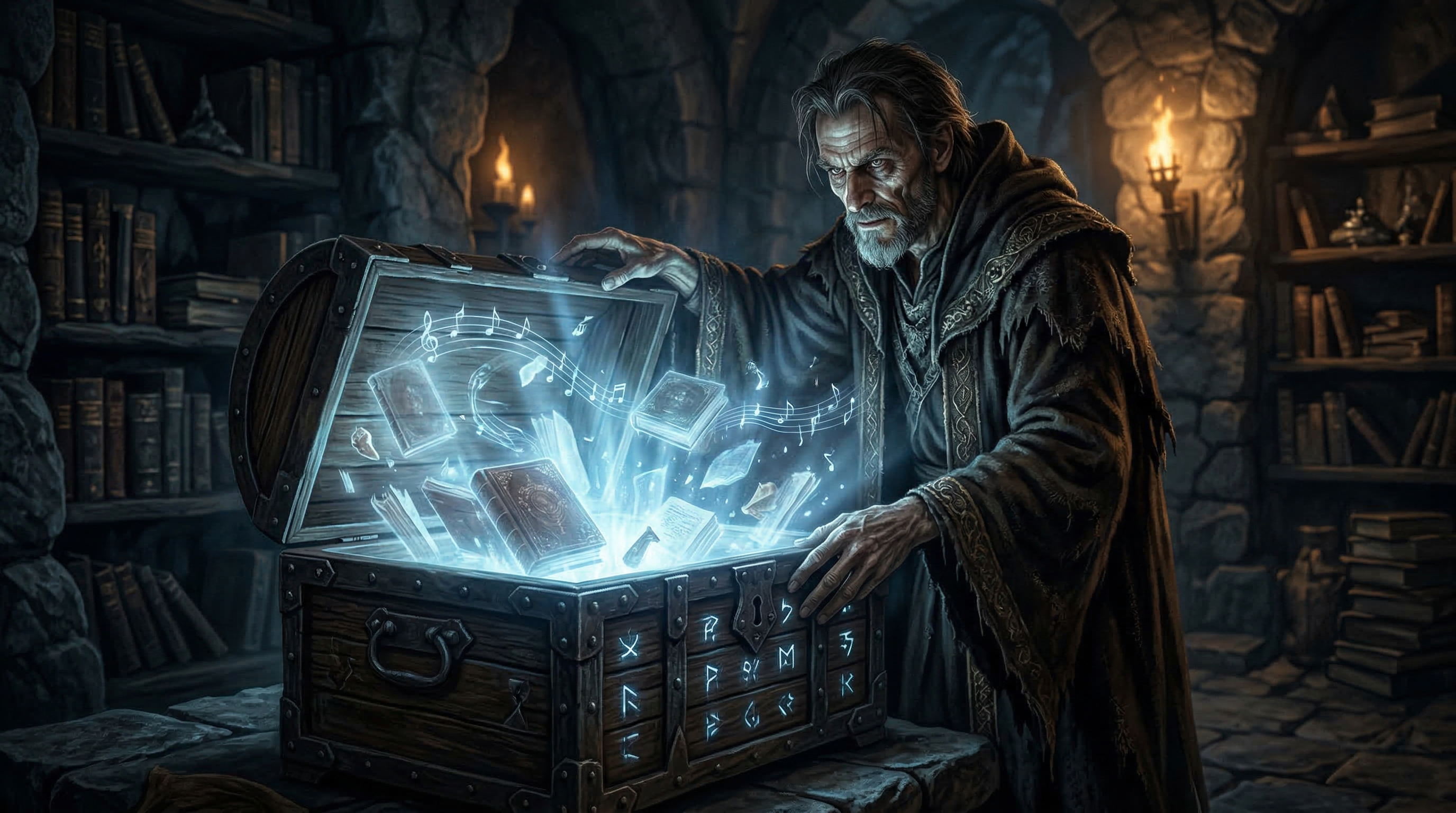
Imagine there was a magician. Not a great one. One who can just about manage fireballs and occasionally an iron golem – which then, because irony is a law of nature, melts back into its own fire.
And now the magician steals books from other magicians. Not because he can read them. But because possession already looks like power.
He puts his loot in an enchanted chest and rents it out to more talented magicians. They quickly figure out how to open it: if necessary, with their foot, usually with the key stuck to the bottom, or, if they want to feel elegant, with the spell: “Give me the books.”
Who should now be punished by the Council of Mages: the money-hungry chest renter? Or Lisa Hexenhild, who only conjures up one book from it?
Fourth: All other lines of defense—cleared.
- Right to quote (Section 51 UrhG)? An AI model does not engage in “intellectual debate” with a work (para. 285).
- Pastiche (§ 51a UrhG)? Requires an artistic personality, which AI does not have (para. 287).
- Private copying (§ 53 UrhG)? OpenAI is a legal entity, not a person with a private CD shelf (para. 289).
- Scientific research (Section 60d UrhG)? OpenAI is not a research institution – too much profit flows into the pockets of investors instead of back into research (paras. 212–214).
Fifth: Public disclosure ⇒ yes. The song lyrics are accessible to anyone, anytime, anywhere via the chatbot. This is a “new audience” that the rights holder did not have in mind when the song was originally published (paras. 266–273). Rolf Zuckowski wrote his birthday song for children’s birthday parties. Not for a chatbot with 100 million users.
Gundula Gernehex wrote her notes for herself (or for her daughter Erneliese), but not for Lisa Hexenhild.
And certainly not for a money-hungry magician.
THE RESULT
The lawsuit was approximately 80% successful. All copyright claims—injunctive relief, disclosure, damages on the merits, publication of the judgment—were awarded (cost ratio: 80% defendant, 20% plaintiff; pre-trial attorney’s fees: EUR 4,620.70 from a value in dispute of EUR 480,000).
The 20% that GEMA lost is nevertheless interesting. In addition to copyright exploitation rights, GEMA also claimed a violation of general personality rights (paras. 301–308). The argument: ChatGPT hallucinates. The model does not always reproduce song lyrics verbatim – randomization at the decoding level distorts passages. Nevertheless, these distorted texts are attributed to the original authors. If you ask ChatGPT about “Männer” by Herbert Grönemeyer, you get a version Grönemeyer never wrote – but the system presents it under his name. GEMA saw this as an untrue factual claim about authorship and thus an infringement of the authors’ personal rights – a right that, in addition to the prohibition of distortion (§ 14 UrhG), also protects authors from having works attributed to them that have been altered without their consent.
The court rejected this argument. Memorization and regurgitation neither “attribute” other people’s works to the authors nor lead to any other violations of personal rights (CMS Hasche Sigle, discussion dated November 19, 2025, CMS Blog).
There is also a procedural problem: general personal rights are highly personal rights. GEMA exercises exploitation rights on a fiduciary basis. Personal rights remain with the authors themselves.
Nevertheless, from the perspective of creative professionals, the hallucination problem is real. If a language model outputs a text under the name of an author who never existed, then that is – copyright or not – a misattribution. The fact that the 42nd Chamber did not go along with this does not mean that the argument is settled. It means that it must be raised again in the correct proceedings by the correct plaintiffs – the authors themselves.
A referral to the ECJ was rejected (paras. 309–312) even though the Hungarian referral C-250/25 (Like Company/Google Ireland) is pending before the ECJ.
The appeal is pending before the Munich Higher Regional Court, ref. 6 U 3662/25 e.
2.3 KNESCHKE VS. LAION: THE SAME PARAGRAPH, TWO COURTS, TWO ANSWERS
Remember the magician’s chest? In Munich, the court ruled that anyone who fills their chest with stolen magic books and then rents it out is liable as the perpetrator—not the user who takes a quick peek inside.
Now let’s go to Hamburg. Same paragraph—at least in the appeal. Similar question, different phase.
And now the plot twist: different answer.
Robert Kneschke is a stock photographer. No major label, no publishing house – just a single creative person who makes a living from his pictures. He is suing LAION e.V., a non-profit association that created the LAION-5B dataset: around 5–6 billion image-text pairs, freely available on the internet. Among them: Kneschke’s photos (LG Hamburg, judgment of September 27, 2024 – 310 O 227/23, MMR 2024, 973; OLG Hamburg, judgment of December 10, 2025 – 5 U 104/24, MMR 2026, 140).
Kneschke loses. In both instances.
In the first instance (Hamburg Regional Court, 310 O 227/23), the scientific research barrier (§ 60d UrhG – closely related to § 44b UrhG) applies. That commercial companies also use the data set? It doesn’t matter. The primary purpose of the data collection is decisive. § 44b UrhG is only touched upon as obiter dictum – an assessment that the court expresses without it being decisive for the decision.
In the appeal (Hamburg Higher Regional Court, 5 U 104/24), § 44b is then affirmed independently. And this is where it becomes relevant to the GEMA vs. Suno question: The Higher Regional Court interprets the term TDM – i.e., text and data mining, the legal exception for automated data analysis – broadly. Patterns, trends, correlations? Just examples of rules. Automated image-text comparison is also “information extraction” (para. 69). And – drum roll – the court rejects a teleological reduction (i.e., the restrictive interpretation of a norm contrary to its wording because the purpose of the law requires it) : The legislature wanted § 44b to apply to AI (with reference to Art. 53 (1) (c) AI Regulation and BT-Drs. 19/27426, p. 88).
To stay with the language of magicians: LAION does not put the books in the chest permanently. It opens each book once, notes the title and content on a label – and puts the book back. The Higher Regional Court of Hamburg says: Cataloging is permitted data evaluation.
If you follow Munich’s logic, a different picture emerges: If the next magician finds the books using your labels, acquires the secret knowledge (and uses) ⇒ then your catalog was the first step towards copyright infringement.
The distinction is important: Hamburg rules on phase 1 ⇒ compiling the data set.
Munich rules on phases 2 and 3 ⇒ memorization and output. The separation of phases makes a factual difference.
But the dogmatic statements on the scope of Section 44b diverge fundamentally. The Federal Court of Justice will have to clarify this. The appeal has been granted: Ref. I ZR 281/25.
Added to this is the opt-out problem (Section 44b (3) UrhG): The Higher Regional Court of Hamburg distributes the burden of proof in two stages. The user (LAION) must prove that a reservation exists. The rights holder must prove that the reservation was machine-readable. This is precisely where Kneschke fails: he was unable to prove that technologies existed in 2021 that could automatically recognize his reservation formulated in natural language in his terms and conditions.
A photographer who does everything right – reservation in the terms and conditions, no free licenses, professional exploitation – fails because the technology in 2021 was not yet advanced enough to read his objection.
It’s like saying to the master witch whose knowledge was stolen from her spell book: “You may have cast a protective spell on the cover, but the thief had an older wand that couldn’t read your spell. So he’s not liable.”
2.4 PROMPTING IS NOT CREATING = WHO OWNS THE AI OUTPUT?
Change of perspective. Until now, the question has been: Is AI allowed to use other people’s work? Now the counter-question:
Does the user own what the AI spits out?
On February 13, 2026, the Munich Local Court ruled: No (Munich Local Court, final judgment of February 13, 2026 – 142 C 9786/25, GRUR-RS 2026, 1513).
(See also my blog post, without which the ruling would certainly not have been possible ;) => medium.com)
All joking aside. After all, we are in the land of magicians. This is serious business.
What was it about? A 1,700-character prompt for a logo. The court says: not enough. If the AI makes the essential design decisions, there is no personal intellectual creation (paras. 24–27) . Copyright does not reward investment, time spent, or diligence—only the result of creative activity (para. 22).
Back to the magician: You can tell him what color the rabbit should be. You can determine the size of the top hat and the order of the tricks. But when the magician puts on the show—it’s his show. Not yours.
The consequence for AI music: anyone who generates a song using Suno does not acquire copyright to it. The output is in the public domain. And that creates a paradoxical interaction: if the output is not protected, the inputs – the protected original works on which it was trained – are all the more worthy of protection.
Thilo Klawonn summed it up in his dissertation: “There are AI creations, but no AI works” (Klawonn, Artificial Intelligence, Music, and Copyright, Mohr Siebeck 2023, p. 67). The European concept of a work requires that the personality of the author be expressed in the work (ECJ C-310/17, Levola/Smilde). AI has no personality. Therefore, it has no authorship. Therefore, it has no protection.
A personal note at this point: In my blog article at the time, I outlined five scenarios – from the “button pusher” who presses ‘generate’ and takes whatever comes, to the “tool user” who uses AI like an instrument and actively makes creative decisions. The Munich Regional Court has essentially confirmed this gradation.
The question many of you are now asking yourselves is: What if I’m not a button pusher? What if – as I do myself – I write the lyrics completely by myself, have parts of the music generated by Suno, but then edit the result in my DAW, swap tracks, change arrangements?
Then, according to the logic of the Munich Regional Court, you are closer to being a “co-composer” or “tool user.” Your own lyrics are indisputably your work (Section 2 (1) No. 1 UrhG). You have no copyright on the AI-generated parts of the music—but you may have copyright on the overall arrangement you build from them. The decisive factor is whether your creative decisions shape the final result—not which tool you used.
However, there were two points I underestimated at the time:
Firstly, I wrote that copyright infringements by AI-generated music were “rather unlikely” because modern AI systems do not copy, but generate new content from learned patterns. In the OpenAI ruling, the Regional Court of Munich I showed that this was too optimistic – memorization does take place, and outputs can reproduce training data (paras. 181–189 of the Munich Regional Court ruling).
Second, I considered the user to be primarily liable and the AI provider to be merely a “disturber” who only has to intervene after becoming aware of the situation. The court reversed this: OpenAI is liable as the direct perpetrator (paras. 275–278). It is not the user who enters a simple prompt who has control over the act, but the provider who selected the training data, is responsible for the architecture, and created the memorization risk.
What does this mean for you as a user? It depends on what you prompt. Bird & Bird summarizes the Munich line as follows: “User prompts merely trigger the model’s internal processes and do not create independent liability. “ And the Kluwer Copyright Blog (based on Leistner, GRUR 2025, 955) makes a precise distinction:
- You enter an open, short prompt (”Make me a happy song”) and the output happens to contain copyright-infringing material? Then the provider is liable. Because the infringement stems from the training, not from your prompt. You neither intended nor caused it.
- You enter a specific prompt (“Generate me a song in the style of Herbert Grönemeyer with the melody of ‘Männer’”) and the output infringes copyright? Then you are liable – as the direct reproducer. Because in this case, you determine the infringing content, not the model.
In short: The more precisely your prompt targets a specific protected work, the closer you are to being the perpetrator. The more open your prompt, the more responsibility lies with the provider.
2.5 DABUS: AI CANNOT BE AN INVENTOR
Last building block. This time it’s not copyright law, but patent law – but the parallel is obvious.
On June 11, 2024, the Federal Court of Justice ruled that AI cannot be an inventor (Federal Court of Justice, decision of June 11, 2024 – X ZB 5/22, GRUR 2024, 1315, para. 21). An inventor within the meaning of Section 37 (1) PatG can only be a natural person. The transfer consideration to copyright law is obvious: if AI cannot be an inventor, then it certainly cannot be an author (Section 7 UrhG) . Both standards require a human being. The inventor’s moral rights correspond structurally to the author’s moral rights (cf. Gärtner, note on BGH GRUR 2024, 1315).
The BGH also clarifies: For the status of inventor, a human contribution that has “significantly influenced” the overall success is sufficient (marginal nos. 38–39). Applied to Section 2 (2) UrhG: A Leonardo da Vinci moment is not necessary. But it also requires more than a prompt.
Or, to put it in magician’s terms: You don’t have to be able to perform magic yourself. But you must have given the magician more than just a shopping list.
2.6 THE EXPERT OPINION CITED BY BOTH SIDES
So far, judgments. Now a document that is not a judgment, but has had more impact than most.
In August 2024, Tim W. Dornis and Sebastian Stober analyzed in a 171-page document whether Section 44b UrhG is applicable to generative AI training (Dornis/Stober, Copyright and Training Generative AI Models, SSRN 4946214, SSRN). Client: the Copyright Initiative, an umbrella organization representing over 140,000 European authors. The expert opinion was presented to the European Parliament on September 5, 2024, at the invitation of MEP Axel Voss. The law firm Raue (GEMA lawyers) has incorporated it directly into its legal proceedings. And the Munich I Regional Court has taken up the central arguments in the OpenAI ruling.
The result in a nutshell: Section 44b UrhG does not apply to generative AI training.
The summary of the four arguments:
Wording. Section 44b defines TDM – text and data mining – as “automated analysis to extract information.” However, generative AI models do not extract information. They produce it. And in doing so, they extract semantic and syntactic information indiscriminately – including copyright-protected expressions: style, structure, form.
Technology. Generative models cannot separate semantic and syntactic information. “They are not designed for this purpose and are also technically incapable of doing so” (Dornis/Stober, p. 77).
History. The DSM Directive (Digital Single Market – the EU copyright directive for the digital single market) of 2019 does not mention the term “artificial intelligence” even once. Dornis/Stober call it a “relic of the AI Stone Age.”
Three-step test. Even if § 44b were applicable, the three-step test (Art. 5(5) InfoSoc Directive) prevents it. Generative AI training impairs the “normal exploitation” of the works. Substitution effects threaten the exploitation markets. And the opt-out? ‘Ineffective’ and “practically largely circumventable.”
3. SECTION 44B URHG – ONE STANDARD, ZERO CLARITY
Remember: In section 2.3, Munich and Hamburg ruled differently on the same paragraph. Dornis/Stober support Munich’s narrow interpretation. The Hamburg Higher Regional Court refers to the AI Regulation (Art. 53 (1) (c)) to justify the broad interpretation. Dornis/Stober disagree: The AI Regulation only refers to existing copyright law—without changing it (Dornis/Stober, SSRN 4946214, § 4.D.I.5).
The irony: both sides cite the same law. And come to the opposite conclusion.
Who is right? We don’t know. Not yet. But the clock is ticking:
BGH, Ref. I ZR 281/25 — the appeal of the OLG Hamburg ruling. The first BGH decision on § 44b UrhG and AI training. 2027 at the earliest.
ECJ, C-250/25 (Like Company/Google Ireland) — the Hungarian referral asks exactly the right questions: Is AI training a “reproduction”? Does the TDM exception apply? Also not before 2027.
In the language of magicians: The spell that regulates who is allowed to use other people’s spell books is written in two dialects. And the Supreme Council of Magicians has not yet decided which one applies.
What does this mean for you? Maximum legal uncertainty. No opt-out solves this. No compliance framework covers this. The compliance stack for AI music has a hole in the middle – and that hole is called Section 44b of the German Copyright Act (UrhG).
4. BEYOND THE ATLANTIC: LAWSUITS, DEALS, AND A SYSTEM THAT ONLY WORKS FOR THE BIG PLAYERS

While Germany is arguing about Section 44b UrhG and waiting for the Federal Court of Justice, the facts have long since been established in the US. And whatever one may think about current US politics, the rule of law works. It just doesn’t work the same for everyone.
The key difference between the two systems is that German copyright law focuses on the author as a person—their personality, their creation. US copyright law is economically oriented—it’s about exploitation, market share, dollars. But in the end, both systems often come to the same conclusion. Just by different means.
4.1 THE LAWSUIT FRONT
Since June 2024, Sony, Universal, and Warner—united under the umbrella of the RIAA (Recording Industry Association of America)—have been suing AI music generators Suno and Udio for training on copyrighted recordings without a license. Liability risk: billions (RIAA, press release dated June 24, 2024, RIAA).
In October 2025, independent musicians follow suit with class action lawsuits that go beyond copyright: stream ripping from YouTube as a training source, infringement of personal rights through the use of voice and style (Copyright Alliance, November 3, 2025, Copyright Alliance).
And the legal battle is no longer confined to the US. GEMA is suing in Munich. The Danish Koda (52,000 members) is suing in Copenhagen – its CEO calls it the “biggest theft in music history” (Koda, press release dated November 4, 2025, Koda). The figures behind this: The GEMA/SACEM Goldmedia study estimates a cumulative loss of €2.7 billion for German and French rights holders by 2028. A Harvard Business School study commissioned by Koda forecasts €921 million for Denmark alone by 2030.
The legal battle is global. But what happens next is what’s really interesting.
4.2 LAUNCH, TRAIN, SETTLE
Forbes named the pattern in December 2025: “Launch, Train, Settle: How Suno and Udio’s Licensing Deals Made Copyright Infringement Profitable” (Forbes, Dec. 18, 2025, Forbes).
Launch. Bring the product to market. Acquire users. Prioritize growth.
Train. Train the model on millions of copyrighted works – without a license. Cost: zero.
Settle. Once the lawsuits come, negotiate with the big players. Warner: Settlement with Suno and Udio in November 2025. Universal: Settlement with Udio in October 2025. The terms: Opt-in for artists, download restrictions, new licensed models from 2026 (Hollywood Reporter, 11/25/2025, Hollywood Reporter).
Following the Warner settlement, Suno is valued at $2.45 billion (Hollywood Reporter, November 25, 2025). The licensing costs? A fraction of the company’s value. The penalty for unlicensed training? There is no penalty. There is a settlement.
Who is sitting at the negotiating table? The majors. Who is not sitting at the table? The indies. The collecting societies. The Robert Kneschkes of this world.
The result: a two-tier system. Major artists get protection. Indies get nothing.
A startup from Los Angeles shows that there is another way: Klay Vision is developing a “Large Music Model” trained exclusively on licensed music. All three majors have licensed their catalogs (Reuters, 11/19/2025, Reuters). The proof: Training without licenses was not a technical necessity. It was a business decision.
4.3 THE MONEY FLOWS UPWARDS
The pattern is not new. It just has a different name.
At Spotify, approximately 55% of every euro of streaming revenue goes to the labels, approximately 30% to the platform, and approximately 13% to the artists (IP Business Academy, February 24, 2025, IP Business Academy). Universal negotiates higher per-stream rates than indies – “One UMG stream is going to earn more than one indie artist stream. From the identical listener” (Ari’s Take, January 30, 2025, Ari’s Take). Spotify pays between $0.003 and $0.005 per stream – to the rights holder, not the artist (Michigan Journal of Economics, January 29, 2024, Michigan Journal of Economics).
At Spotify. On Suno. The system is consistent.
It’s just not fair.
The consequence: if Suno settles with the majors, it becomes the gatekeeper. It is then not GEMA that determines how AI music is remunerated, but the bilateral agreement between a startup and three labels.
4.4 THE EU AI ACT: REGULATION OR COMPLIANCE THEATER?
The EU AI Act (Regulation (EU) 2024/1689) attempts to set a framework here. Art. 53 (1) (c) obliges GPAI providers (General Purpose AI – i.e., providers of AI models for general purposes) to develop a strategy for complying with EU copyright law and to respect opt-outs under Article 4(3) of the DSM Directive. Article 53(1)(d) requires the publication of a “sufficiently detailed summary” of the training data. The mandatory submission will become binding on August 2, 2026. Sanctions: up to €15 million or 3% of global annual turnover (Article 101 of the AI Regulation).
The GPAI Code of Practice – a voluntary code of conduct intended to specify the obligations under Article 53 of the AI Regulation – (final version July 10, 2025) contains four commitments on copyright: Technical implementation of opt-out, transparency regarding training sources, procedures for rights holders, no training on illegally obtained data (Wendt/Wendt, Das neue Recht der Künstlichen Intelligenz [The New Law of Artificial Intelligence], 2nd ed. 2025, § 11 Rn. 33; Leistner, GRUR 2025, 1123, 1129).
But the Code of Practice is voluntary. Meta refused to sign on July 18, 2025 (Wendt/Wendt, loc. cit.). And even those who do sign enjoy a one-year grace period.
Regulation through voluntary action. In an industry that has just proven that “launch, train, settle” works.
That’s not regulation. That’s compliance theater.
4.5 UPDATE
Update March 9, 2026: The oral hearing took place – in a packed Room 270 of the Munich Palace of Justice. Judge Elke Schwager (the same judge who handed down the OpenAI ruling in November 2025) had six songs played in their original and AI versions: “Forever Young” (Alphaville), “Atemlos” (Kristina Bach), “Mambo No. 5” (Lou Bega), “Rasputin” (Boney M), “Big in Japan” (Alphaville), and “Daddy Cool” (Boney M). Suno argued that the model does not memorize music, but merely generates “mathematical randomness.” The judge recommended that the defendant reach a settlement, referring to her own chamber’s OpenAI ruling (SZ, March 9, 2026, sueddeutsche.de). No ruling was issued. Announcement date: June 12, 2026 (GEMA, press release dated March 9, 2026, https://www.gema.de/de/w/gema-klagt-gegen-suno-2026; Music Business Worldwide, March 9, 2026, musicbusinessworldwide.com).
5. FAQ: WHAT DOES THIS MEAN FOR YOU AS AN AI MUSIC USER?
5.1 AM I LIABLE IF I CREATE MUSIC WITH SUNO/UDIO?
The short answer: It depends.
The long answer requires some differentiation.
Private use vs. commercial use: If you generate a song using Suno and listen to it on your own phone, you won’t get a warning. Section 53 of the German Copyright Act (UrhG) (private copying) applies to natural persons and private purposes. Problems arise with commercial use – i.e., publication on Spotify, YouTube, TikTok, or use as background music for a product.
Who is primarily liable – the user or the platform? The Munich I Regional Court clarified this in the OpenAI ruling: In the case of simple prompts, the AI provider is liable as the direct perpetrator, not the user (paras. 275–278). But – and this is the crucial point – in the case of targeted prompt engineering, this can change. Baumann/Nordemann/Pukas put it this way in GRUR 2025, 955, 960: “If the user specifically causes the infringement through prompts, in particular through corresponding prompt engineering, the act of reproduction will be attributable to them.”
The normative doctrine of attribution asks: Who primarily determines the content of the output? In the case of open, concise prompts: the AI provider (because the result is due to deficiencies in training). In the case of targeted prompts (“Generate a song in the style of Herbert Grönemeyer with the melody of ‘Männer’”) : the user.
Interference liability (§ 97 UrhG)? Conceivable if the user is aware of the training problem and still uses the output commercially. However, the threshold is higher than for perpetrator liability: there must be a concrete violation of a reasonable duty to check.
The comparison: someone who plays a stolen instrument is not stealing the music. But anyone who knowingly uses a copyright-contaminated tool commercially and monetizes the output is operating in a gray area that is becoming narrower with every court ruling.
5.2 WHAT HAPPENS IF THE COURTS FIND LIABILITY – FOR SUNO, AND THEN FOR ME?
Injunction claims (Section 97 (1) UrhG): Suno would have to refrain from distributing infringing outputs. Technically, this could require a redesign of the model – or blocking certain prompts.
Damages (Section 97 (2) UrhG): Calculation by way of license analogy – i.e., based on the amount Suno would have had to pay if it had properly acquired a license in advance. The GEMA two-pillar model provides a guideline: 30% of net income.
Retroactive effect on already published tracks? This is where it gets legally tricky. Section 97 UrhG also grants damages for past infringements (in cases of fault). So anyone who has published an AI-generated track on Spotify and the track contains memorized elements of a GEMA work is theoretically vulnerable. In practice? The burden of proof lies with the rights holder. But with increasing transparency of training data (Art. 53 (1) (d) AI Regulation, mandatory submission from August 2, 2026), this burden of proof will become easier to bear.
Platform vs. user: Primary liability lies with the AI provider. But secondary liability on the part of the user is not excluded – in particular under Section 97(2) sentence 1 UrhG (fault) and Section 97(2) sentence 3 UrhG (enrichment). Anyone who knowingly uses an illegal tool and generates income with it will find it difficult to claim ignorance – if the illegality of the training has been established in court.
This is the point at which the liability architecture changes. Before the GEMA vs. OpenAI ruling: arguable good faith. After the ruling: knowledge of the case law is assumed. And after a possible Federal Court of Justice ruling on Section 44b UrhG? Then the game is up.
Baumann/Nordemann/Pukas therefore propose a system of traffic obligations – i.e., a catalog of due diligence obligations, compliance with which reduces the liability risk – for AI providers: diverse training data, blacklists with hash procedures, prompt filters, user instructions (GRUR 2025, 955, 960 f.). Those who comply with these obligations reduce their liability risk. Those who ignore them are liable as perpetrators. The user is liable as an indirect instigator – or as a direct perpetrator if they deliberately cause the infringement.
5.3 DOES MY OWN AI WORK PROTECT COPYRIGHT?
No. At least not if it is purely AI-generated.
The Munich Local Court has formulated this unequivocally: AI-generated products only have the character of a work if human influence shapes the output in a “sufficiently objective and clearly identifiable” manner (Munich Local Court, 142 C 9786/25, GRUR-RS 2026, 1513, official headnote 2). Even iterative, time-consuming editing is not sufficient if the AI makes the essential creative decisions.
Klawonn confirms this finding in his dissertation: Authorship of AI music can only be attributed via the criterion of immediacy – humans must have had a direct influence on the final result. “Simply triggering the AI process is not enough” (Klawonn, AI, Music, and Copyright, Mohr Siebeck 2023, p. 67 ff.).
The gray area: post-processing. Anyone who takes the AI output and edits it substantially—changing melody lines, rewriting arrangements, adding their own lyrics—may, under certain circumstances, obtain copyright protection for the editing. But here, too, copyright only protects the human contribution. The AI-generated foundation remains in the public domain.
Rohrlich puts it pragmatically: “Since only humans can currently be considered authors within the meaning of the UrhG, ‘works’ generated by AI are not classified as such in the copyright sense. Therefore, the legally correct term is ‘AI products’” (Rohrlich, KI und Recht, Carl Hanser Verlag 2025, p. 46).
And Wandtke/Bullinger/Thum confirm the dogmatic basis: Anyone who merely enters an idea or a brief prompt into AI behaves legally like an idea generator or work inspirer according to Section 7 UrhG – without their own creative design, no copyright arises (Wandtke/Bullinger/Thum, UrhG § 7 Rn. 13, 4th ed. 2014).
The distinction between categories of works exacerbates the problem: anyone who only provides text specifications to a text-to-music AI does not make a compositional creative contribution. The creative contribution would have to be made in the same work category as the output.
5.4 WHAT SHOULD I DO NOW IN CONCRETE TERMS?
Pragmatic recommendations for action:
1. Document your creative contributions. If you use AI as a tool, keep track of the decisions you have made. Which melody lines did you change? Which arrangements are yours? The burden of proof for authorship lies with you.
2. Do not publish commercially as long as the legal situation is unclear. Anyone who puts an AI-generated track on Spotify today is taking a calculable but real risk. If the Munich I Regional Court confirms training liability in the GEMA vs. Suno case, platforms will react.
3. Keep an eye on licensing models. Suno will introduce new, licensed models in 2026. Tracks created with these models will have a different risk profile than tracks from the current, unlicensed trained models.
4. Follow three cases:
- GEMA vs. Suno (LG Munich I, 42 O 763/25) – heard on March 9, 2026, judgment announced on June 12, 2026. First European ruling on AI music?
- BGH, I ZR 281/25 – Appeal of the OLG Hamburg ruling on Section 44b UrhG. The landmark decision.
- ECJ, C-250/25 (Like Company/Google Ireland) – The first ECJ referral on AI and copyright. Judgment not before 2027.
5. Consider alternatives. Klay Vision shows that there are licensed AI music models. If you want to be on the safe side, use tools that have been trained exclusively on licensed data.
CONCLUSION
Suno decided to train without licenses. This was not a technical necessity. Klay Vision proves it. It was a business decision – and it paid off. $2.45 billion valuation. 100 million users. And then a settlement that turns the licensing costs into a footnote.
German copyright law has an answer to this. But it is still incomplete. Two courts. One standard. Zero clarity. The Federal Court of Justice will decide. The European Court of Justice will decide. Until then, the following applies: Anyone who uses AI music commercially is building on a foundation that is being renegotiated in real time.
On March 9, 2026, GEMA set a precedent in Munich. On June 12, 2026, the court will decide. Not only on the six songs in the case. But also on the question of whether creativity has a price – or whether it becomes a free training resource.
The technical findings on memorization are empirically proven. Carlini et al. (2023, ICLR – International Conference on Learning Representations, one of the leading AI research conferences) have proven that current generative models memorize between 0.1% and 10% of their training data directly. Three factors increase the memorization rate: model size (larger models store 2–5x more), data duplication (frequently repeated examples are more extractable) and context (longer prompts increase extractability by orders of magnitude). Similar findings are emerging for audio and video data (Dornis/Stober, SSRN 4946214, § 2.D.III, with reference to Bralios et al. 2024; Rahman et al. 2024).
This is the technical basis for the Munich Regional Court ruling. And it is the reason why Suno is on trial.
Dornis and Stober conclude their expert opinion with a warning: “Farewell to human exceptionalism.” There is no guarantee that human creativity will be able to compete with the growing capacities of algorithmic production in the medium term. There will be no increase in human creativity due to an abundance of AI output. Instead, there will be displacement. In journalism. In entertainment. In everyday productions. And then, at some point, everywhere (Dornis/Stober, SSRN 4946214, § 6).
The answer to this will not come from Silicon Valley. Not from Room 270 of the Munich Palace of Justice. And not from a settlement agreement.
It will come from whether we as a society are prepared to define the difference between a tool and theft.
And then: to enforce it.
SOURCE LIST
GERMAN JUDGMENTS
- LG Munich I, final judgment of November 11, 2025 – 42 O 14139/24, GRUR-RS 2025, 30204 (GEMA vs. OpenAI). Appeal: OLG Munich, Ref. 6 U 3662/25 e. URL: https://www.gema.de/de/w/grundsatzurteil-gema-gegen-openai
- Higher Regional Court of Hamburg, judgment of December 10, 2025 – 5 U 104/24, MMR 2026, 140 (Kneschke vs. LAION). Appeal: Federal Court of Justice, Ref. I ZR 281/25
- Hamburg Regional Court, judgment of September 27, 2024 – 310 O 227/23, MMR 2024, 973 (Kneschke vs. LAION)
- AG Munich, final judgment of February 13, 2026 – 142 C 9786/25, GRUR-RS 2026, 1513 (AI-generated logos)
- Federal Court of Justice, decision of June 11, 2024 – X ZB 5/22, GRUR 2024, 1315 (DABUS/AI as inventor)
PENDING PROCEEDINGS (GERMANY/EU)
- Munich Regional Court I – 42 O 763/25 (GEMA vs. Suno), heard on March 9, 2026, judgment announced on June 12, 2026. URL: https://www.justiz.bayern.de/gerichte-und-behoerden/landgericht/muenchen-1/presse/2026/1.php; GEMA press release dated March 9, 2026: https://www.gema.de/de/w/gema-klagt-gegen-suno-2026
- Federal Court of Justice – I ZR 281/25 (appeal Kneschke vs. LAION)
- ECJ – C-250/25 (Like Company/Google Ireland, referral dated April 3, 2025)
US PROCEEDINGS
- RIAA vs. Suno Inc. – D. Mass., Case 1:24-cv-11611-FDS (filed 24.06.2024). URL: https://www.riaa.com/record-companies-bring-landmark-cases-for-responsible-ai-againstsuno-and-udio-in-boston-and-new-york-federal-courts-respectively/
- RIAA vs. Uncharted Labs Inc. (Udio) – SDNY, Case 1:24-cv-05285 (filed June 24, 2024)
- Indie Class Action (Woulard, Burjek et al.) vs. Udio and Suno – October 2025. URL: https://copyrightalliance.org/copyright-news-october-2025/
SETTLEMENTS AND DEALS
- WMG/Suno Settlement – November 25, 2025. URL: https://www.hollywoodreporter.com/music/music-industry-news/warner-music-group-settles-ai-infringement-suit-with-suno-1236435516/
- WMG/Udio Settlement – November 19, 2025
- UMG/Udio Settlement – October 2025
- Klay Vision licensing deals (all three majors) – November 20, 2025. URL: https://www.wmg.com/news/warner-music-group-signs-ai-licensing-deal-with-music-technology-company-klay; https://www.reuters.com/business/media-telecom/major-music-labels-strike-licensing-deals-with-ai-streaming-startup-klay-2025-11-20/
GEMA SOURCES
- GEMA, press release “GEMA sues Suno” dated January 21, 2025. URL: https://www.gema.de/de/w/pm-klage-gegen-suno
- GEMA, press release “Landmark ruling: GEMA wins against OpenAI” dated November 11, 2025. URL: https://www.gema.de/de/w/grundsatzurteil-gema-gegen-openai
- GEMA, AI licensing model (September 2024). URL: https://www.gema.de/de/w/generative-ki-lizenzmodell-zwei-saeulen
- GEMA/SACEM Goldmedia study (January 2024): AI music market >€3 billion by 2028
LITERATURE
- Dornis, Tim W. / Stober, Sebastian: Copyright and Training Generative AI Models – Technological and Legal Foundations, SSRN 4946214, September 2024. URL: https://ssrn.com/abstract=4946214
- Klawonn, Thilo: Artificial Intelligence, Music, and Copyright, Mohr Siebeck 2023, ISBN 978-3-16-161921-2
- Baumann, Malte / Nordemann, Jan Bernd / Pukas, Jonathan: Liability for copyright infringements in the output of generative AI systems, GRUR 2025, 955–963
- Leistner, Matthias: Copyright and artificial intelligence. A current overview, GRUR 2025, 1123–1133
- Kunitz, Stephan: Copyright challenges in AI-generated works, LTZ 2025, 10–15
- Wandtke/Bullinger/Thum: Practical commentary on copyright law, UrhG § 7 Rn. 12–16, 4th ed. 2014, C.H. Beck
- Rohrlich, Michael: AI and Law, Carl Hanser Verlag 2025, ISBN 978-3-446-48124-4
- Wendt, Janine / Wendt, Domenik H.: The New Law of Artificial Intelligence, 2nd ed. 2025, Nomos
- Ring, Gerhard / Kiefel, Sebastian / Möller-Klapperich, Julia: Copyright, NomosStudium, 1st edition 2021
SPOTIFY / MARKET ANALYSIS
- Forbes: “Launch, Train, Settle: How Suno and Udio’s Licensing Deals Made Copyright Infringement Profitable” dated December 18, 2025. URL: https://www.forbes.com/sites/virginieberger/2025/12/18/launch-train-settle-how-suno-and-udios-licensing-deals-made-copyright-infringement-profitable/
- The Trichordist: “Spotify’s Royalty Threshold Is Conscious Parallelism” dated August 7, 2025. URL: https://thetrichordist.com/2025/08/07/spotifys-royalty-threshold-is-conscious-parallelism-reshaping-the-music-business-but-not-in-a-good-way/
- Ari’s Take: “Spotify And UMG Rigged The Game” dated January 30, 2025. URL: https://aristake.com/spotify-and-umg/
- IP Business Academy: “Economics of Streaming & the Rise of the Music Artists’ Rights.” URL: https://ipbusinessacademy.org/economics-of-streaming-the-rise-of-the-music-artists-rights-and-compensation
EU LEGISLATION
- Regulation (EU) 2024/1689 (EU AI Act), OJ L 2024/1689, entry into force 01.08.2024. URL: https://eur-lex.europa.eu/legal-content/DE/TXT/?uri=CELEX:32024R1689
- GPAI Code of Practice, Final version 10.07.2025. URL: https://digital-strategy.ec.europa.eu/en/policies/ai-code-practice
- Mandatory template for training data summary, 24.07.2025 (binding from 02.08.2026). URL: https://digital-strategy.ec.europa.eu/en/news/ai-office-publishes-mandatory-template-summary-content-used-training-general-purpose-ai-models
INTERNATIONAL PROCEEDINGS
- Koda (Denmark) vs. Suno, Byret København, November 4, 2025. URL: https://koda.dk/en/about-koda/news/koda-sues-us-tech-company-suno-for-stealing-danish-artists-music
- BBC: “Warner settles lawsuit with AI music firm” dated November 25, 2025. URL: https://www.bbc.com/news/articles/cjdrl7lr039o
- Al Jazeera: “Sony, Warner and Universal sign AI music licensing deals with Klay” dated 11/20/2025. URL: https://www.aljazeera.com/economy/2025/11/20/sony-warner-and-universal-sign-ai-music-licensing-deals-with-startup-klay