
SUNO SLAPPED BY GEMA — THE GROUNDBREAKING SUNO RULING EXPLAINED BY A HYBRID (LAWYER & COMPUTER SCIENTIST)
2026-08-01
WHY SHOULD YOU GIVE A SHIT ABOUT ANYTHING I SAY?
Let’s kick this off with a humblebrag so we can get the eye-rolling out of the way: I studied law and computer science. After my legal traineeship—the thing you do after law school in Germany—I spent some time at a Big Law firm. Later, I worked as a cloud solution architect at Microsoft, briefly cosplayed as an interim CTO, and have now crawled back into the warm bosom of Big Law, where I lead AI projects as a freelance tech lead. I’ve been neck-deep in AI for a good five years.
Why am I shoving my résumé down your throat? So you know that, yes, the person writing this is a fucking show-off. But at least he didn’t scrape this article together from twenty ChatGPT prompts.
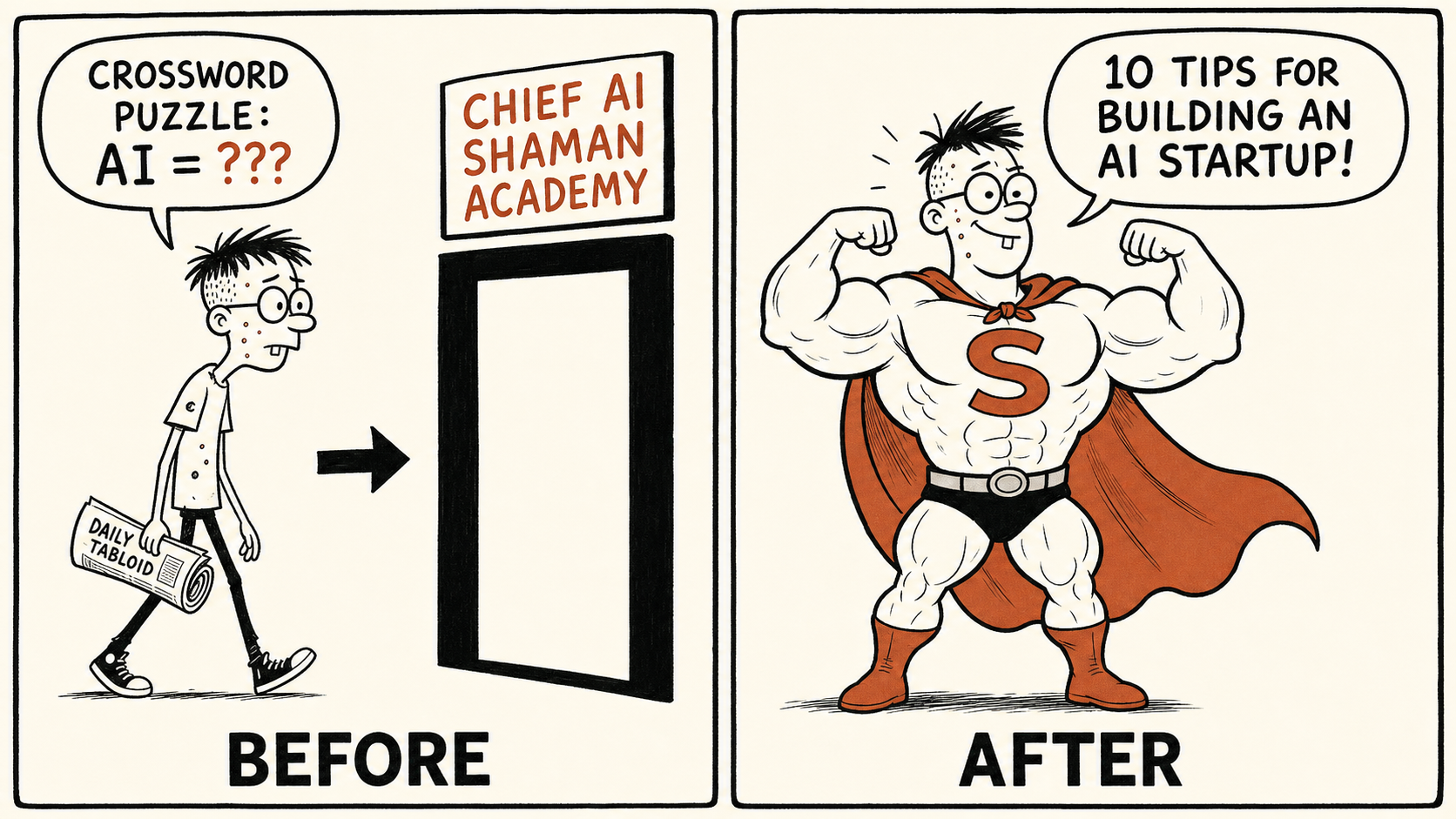
Twenty years of computer science and law. That’s the difference. No Dunning-Kruger fever dream. No fucking clickbait; the new plague is everywhere, including here on Medium: “10 Tips for Building an AI Startup,” written by some washed-up carnival boxer who got “AI” right in a crossword while taking a dump with a trashy tabloid on his knees and is now a Chief AI Shaman who has finally, mercifully, hit puberty.
And that background is the price of admission for this article. If you want to assess the Munich Regional Court ruling of July 31, 2026, on Suno without talking out of your ass, you need both perspectives at the same time. One without the other won’t cut it.
This stuff is complicated. I’m not hiding that.
On the legal side, four heavyweights are waiting to cave your skull in: copyright law, damages law, insolvency law (when looking to the consequences), and private international law. The last one because the Chamber actually applied US law to the US conduct. And lurking in the doorway is international civil procedure, because § 131 VGG first had to establish the German court’s international jurisdiction. Each comes with its own maze of back alleys, its own stop signs and mandatory-turn signs, and its own ankle-breaking potholes.
Then comes the other half of the map: computer science. More precisely, data science, Transformer architecture, how models remember things, and when that remembering turns into too much remembering.
You know the drill, right? Never understood the formula, memorized it anyway. That was me in biology — my second-worst school subject after chemistry. I understood fuck-all and memorized the crap by rote. Result: my twelve-year-old daughter now tutors me in both.
And finally, there’s prompt economics: Who is actually steering whom—the user steering the model, or the model steering the user?
This article only scratches the surface. If you expect an exhaustive treatment, you’re not getting one. That’s what dissertations and specialist journal articles are for.
I’m trying to do what is realistically possible here: expose the switches that actually determine where the train goes.
The immediate trigger for this piece was a Teltarif article about the Suno ruling. This is not me singling out Teltarif for a media flogging. No. This is the norm.
https://www.teltarif.de/ki-musik-gema-suno-urheberrecht/news/105045.html (last visit: 2026–07–31–23:19)
Stories like this are usually written by journalists who know their stuff but have no time. Or by journalists who have all the time in the world but know fuck-all, so they squeeze as much diarrhea as possible out of an AI. Both species at least try to observe journalistic standards such as avoiding blatant one-sidedness. The deadline brigade usually manages that with limited success. And then there’s the clickbait scum. They care about one thing: attention. Either they pump fear into people’s skulls, or they sow the seeds for the comment section to erupt in a warm geyser of gleeful shit.
A quick disclosure, because I can afford myself one: pieces like this eat time—the kind you later feel as a knot in the back of your neck. For this one, I drilled through several rounds of deep research, grilled two councils of frontier-adjacent models, and then smashed every hard claim against apex-court case law until nothing sounded hollow anymore.
Anyone who works with LLMs every day develops a certain tolerance for ambiguity. But every new confabulation (the technical term for hallucination) puts that tolerance through another round of waterboarding. And believe me, there were plenty.
What many of you don’t know is that German law is still, to an absurd degree, knowledge on paper. Unlike the international computer-science world, online legal knowledge has often been locked behind paywalls such as Beck-Online for decades. The greedy AI crawlers that swept across the web after 2022 like a horde of blood-drunk vampires, sucking every mountain of knowledge dry and leaving behind a digital corpse—see Stack Overflow—reached the mountains of German legal knowledge and found an army draped in garlic and armed with wooden stakes.
Meaning: I still have to look up a lot of this in Beck-Online and similar databases because, as I keep discovering, AIs remain spectacularly capable of spewing industrial-grade bullshit with the confidence of a drunk god.
And because I swear more than a drunken sailor on space coke, no AI can properly simulate my raw, abrasive voice, either. Meaning: Yes, I let an AI rough out some prose. Then I have to paint over every square inch of that smooth AI sludge with my own sharp edges.
One more problem, and then we’ll have finished both the bragging section and the poor-me section:
Medium has basically stopped showing my articles to anyone. My latest posts got view counts lower than the IQ of a fruit fly drowning in overproof rum.
I write anyway.
I don’t want Suno users who studied neither law nor computer science stampeding through their timelines with foam around their mouths because some clickbait clown spray-painted “MILLIONS IN LIABILITY!!!” on the wall. Or had ChatGPT spray-paint it for him.
And I equally don’t want the horse-and-buggy crowd smirking and pointing at the drivers—AI users—because their nags suddenly look relevant again.
Because the hatred from the AI-bashing crowd is rarely about the tool and usually not even about its users. It’s projection.
I know the feeling. As a developer, I spent the early days pounding on AI myself.
Why? Because my degree and experience suddenly felt devalued. Overnight, any mouth-breathing dummy could have an app built for them—the sort of thing we developers used to command princely salaries for.
Both sides make me want to puke.
ABOUT MY MUSIC
A word about my music—so that when we reach the custom-voice section, you don’t think I’m pulling this out of my ass. I release music under three names.
RAP (MC Henne): https://www.youtube.com/@mchenne && https://open.spotify.com/intl-de/artist/7h6SoqRgv73KDVw5MdaLER?si=tS_J6ocMReSmWqf0TMODCw
SYNTH POP (ShimGor — with my nephew, who is musically gifted, autistic, part Rain Man and part protagonist of Takis Würger’s Für Polina): https://www.youtube.com/@ShimGor && https://open.spotify.com/intl-de/artist/22jx6Y8bSok8Afx9gybESF?si=8PuBQCgFRmuWwRlJScBRFg
DEATH METAL (Necrotic Awakening): https://www.youtube.com/@NecroticAwakening && https://open.spotify.com/intl-de/artist/0Hdsifqh95uBthV3UMTlLp?si=zdWZ-PKCTbmPQffuWRusHg
Building a fan base on Spotify is brutally hard, especially because music is still only a hobby for me; my day job is freelance IT work. The support that helps most is saving my tracks to your playlists—the algorithm loves that—and starting an artist radio station.
Right. Now to the actual point.
A) THE TECHNICAL SIDE
Before you inspect so much as one section symbol, you need to understand what Suno does technically. Why? Because AI compliance — including AI copyright law — makes sense only if you know both sides of the coin: law and computer science.
SUNO IS A TRANSFORMER, NOT A DIFFUSION MODEL
Suno is not a diffusion model — the kind you often find in image-generating AI. What does diffusion mean? Start with noise, then somehow turn that mess into music.
According to founder Mikey Shulman, including in his conversation with Amplify Partners (https://www.amplifypartners.com/barrchives/how-suno-builds-ai-models-for-musicians, visit 2026–08–01–17:05), Suno is an autoregressive Transformer model.
Meaning: the thing takes audio, chops it into tiny building blocks—tokens, just like the text-choppers do—and then predicts, token by token, what comes next.
Same basic principle as GPT. Except GPT eats words and Suno eats audio.
Why is that more than nerd throat-clearing? Because it lets you draw on the entire body of research into memorization in language models when analyzing Suno. That exact issue sat at the heart of the proceedings that led to the Munich ruling.
MEMORIZATION: WHEN THE MODEL KEEPS THE TRAINING DATA
Memorization means the model does not merely learn “style” and “patterns.” It retains concrete training examples, like chewing gum stuck under a desk, in a form that lets you pull them back out later.
The cleanest methodological analogy comes from Carlini et al.’s work on image diffusion (arXiv:2301.13188—https://arxiv.org/abs/2301.13188—last visit: 2026–08–01–17:06): take the same prompt and setup, then sample with 500 different random starting values, or seeds. If at least 10 out of 500 seeds produce essentially the same output, that is not “creative variation.”
That is memorization.
Important: Carlini is about image diffusion, not autoregressive audio. For Suno, this is an analogy, not a one-to-one transfer. The underlying principle still holds: if a result reproducibly reappears across many seeds, memorization is a more plausible explanation than chance. That is also the logic behind the Munich court’s finding that chance could be ruled out.
Why is that persuasive? Because it blows up every minimizer’s favorite escape hatch: “random coincidence.” Ten near-identical hits out of 500 are not a lucky roll. They are a fingerprint.
STREAM-RIPPING AND DUPLICATION: WHY MEMORIZATION EMERGES STRUCTURALLY
Here comes the bit people love to forget while singing the “Suno is creative!” chorus: duplicates are performance-enhancing drugs for memorization.
The research is aggressively unromantic, and you already know the principle from school: read something once and you might understand it; read it a hundred times and you can recite it in your sleep. Models are no different.
If a song appears only once in the training data, the model learns patterns: how melodies are built, how choruses lock into place, and what a pop song feels like. That is what providers like to sell as “learning style.” And yes, in principle, that is fine.
But if the same song appears dozens or hundreds of times, understanding tips over into rote memorization. The model stops retaining only the pattern and starts retaining the concrete example, allowing it to cough that exact thing back up later—like the student who never understood the formula but can recite the answer key in his sleep.
The study does not establish a universal 100x effect. It found extractable training examples particularly often in heavily duplicated data, sometimes with around 100 or more occurrences. For Suno, that is a strong plausibility argument, not a mathematical risk multiplier.
And this is where Suno gets structurally ugly.
If you drag audio from YouTube and similar platforms into the corpus—the technical term is “stream-ripping”—you do not get “Song X once.” You get Song X in a swamp of variants: reuploads, “official audio,” lyric videos, fan edits, remasters, covers, sped-up versions, slowed-and-reverb versions, and the entire digital landfill. Result: You train on duplicates, so the model memorizes through duplicates.
At that point, matches involving songs such as Atemlos durch die Nacht, Big in Japan, or Mambo №5 are not mystical glitches. They are the predictable result of a data-curation design that eats duplicates like a pig at a trough.
READING GEMA’S EVIDENCE THROUGH A TECHNICAL LENS
In the proceedings we are about to examine, Suno tried to frame the documented matches as the result of “intensive prompt searching.”
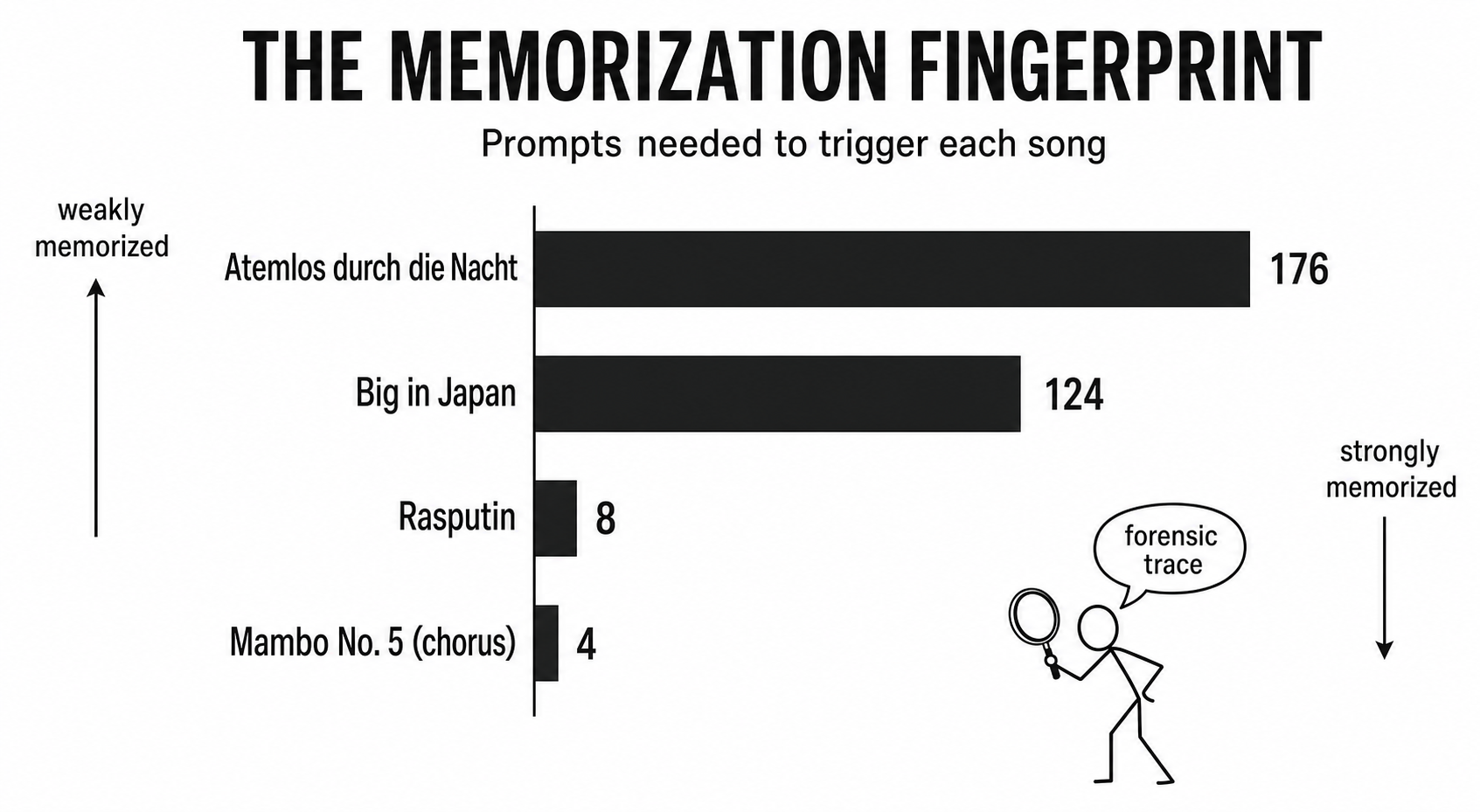
There are 176 documented claimant prompts for Atemlos, 124 for Big in Japan, 8 for Rasputin, and just 4 for the chorus of Mambo №5. Those are not rumored numbers. They appear in Press Release №6 issued by Munich Regional Court I on the oral hearing of March 9, 2026 (https://www.justiz.bayern.de/gerichte-und-behoerden/landgericht/muenchen-1/presse/2026/6.php, visited: 2026–08–01–17:07). Press Release #16 on the decision does not repeat them. Once the full judgment is available, go and check it.
To a layperson, the defense sounds plausible at first: 176 attempts? Then GEMA tortured the model until something vaguely suitable finally fell out. They manufactured the result!
Nope. From a Transformer-research perspective, that is not an exculpatory argument. It is an own goal scored after knocking out your own goalkeeper.
The reason is simple: a prompt does not push anything into the model. It pulls out what is already there. Once training is complete, the model is finished. Frozen. No prompt on Earth changes a single bit of it. Each prompt merely queries that frozen state, like searching a library catalog. You can ask a thousand times. If the book is not on the shelf, you will not get it. And if you finally have it in your hands after attempt 176, it was on that shelf the entire time. Your questions did not conjure it into the library.
That is why 176 prompts are not manipulation. They are diagnostics.
And the distribution is the actual smoke detector. It fits the signature of training paths memorized to different degrees. Weakly memorized works take many prompts before you “hit” them. Strongly memorized ones jump into your face after a handful of tries.
Four prompts for a chorus are not a lucky roll.
That is the burglar’s fingerprint at the crime scene.
THE APT EFFECT: WHY LYRICS WORK AS RETRIEVAL KEYS
The method is called Adversarial PhoneTic Prompting, or APT.
That is exactly what Roh and colleagues tested with Suno (arXiv:2507.17937 — https://arxiv.org/abs/2507.17937 — last visit: 2026–08–01–17:08). They distorted lyrics phonetically, building fragments that sounded like the original but were spelled differently, turning “Atemlos durch die Nacht,” for example, into “Ah Tim los durch die Nacht.”
Not a verbatim quotation. Invisible to any filter staring only at letters.
In the tested Suno-and-YuE setup, APT achieved an average similarity of 91 percent to the originals, compared with 13.7 percent for random lyrics and 42.2 percent for semantic paraphrases.
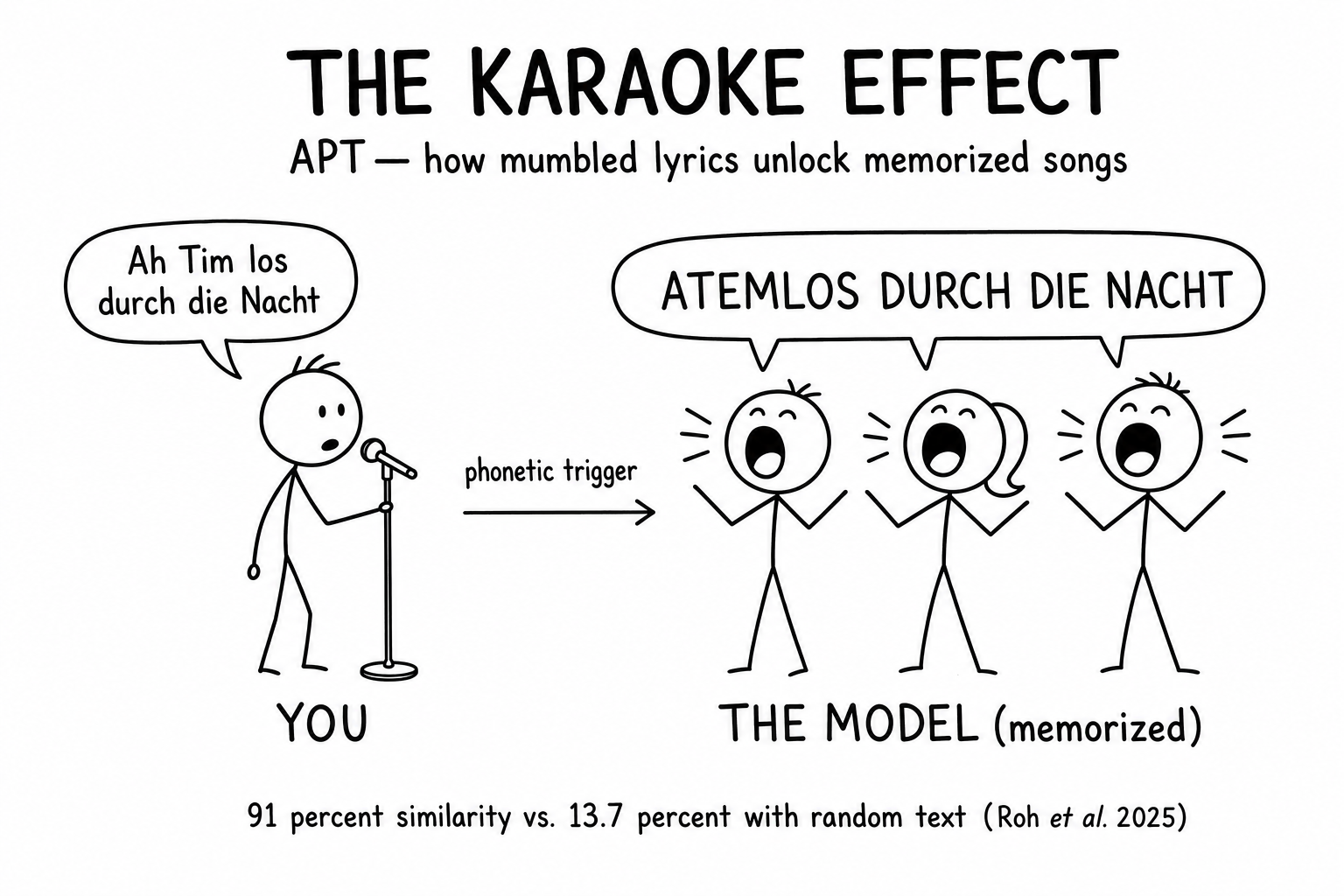
Meaning: lyrics in a prompt are not merely a text template. They are the key that unlocks the door to a memorized work inside the model. Anyone who types a paraphrased line from a protected song into the prompt box turns that key—without quoting verbatim and without malicious intent. That relationship becomes crucial in Section C when we get to custom voice.
That sketches the technical side. It is enough foundation for what follows.
Now for Grandma.
GRANDMA SINGS INSTEAD OF POPPING BENZOS
The Grandma Test comes from law school. Not as an “argument,” but as a slap across the face for elegant answers that are still obviously wrong. One professor put it like this: Check your cases. Then check the result of your analysis. If you can hear your grandma saying, “For God’s sake, that doesn’t make sense from front to back,” check it again.
The Grandma Test does not replace legal analysis. It is a smoke detector. Daniel Kahneman—see https://de.wikipedia.org/wiki/Schnelles_Denken,_langsames_Denken, last visit: 2026–08–01–16:45—would probably call it a smoke detector for “fast thinking.”
Back to Grandma.
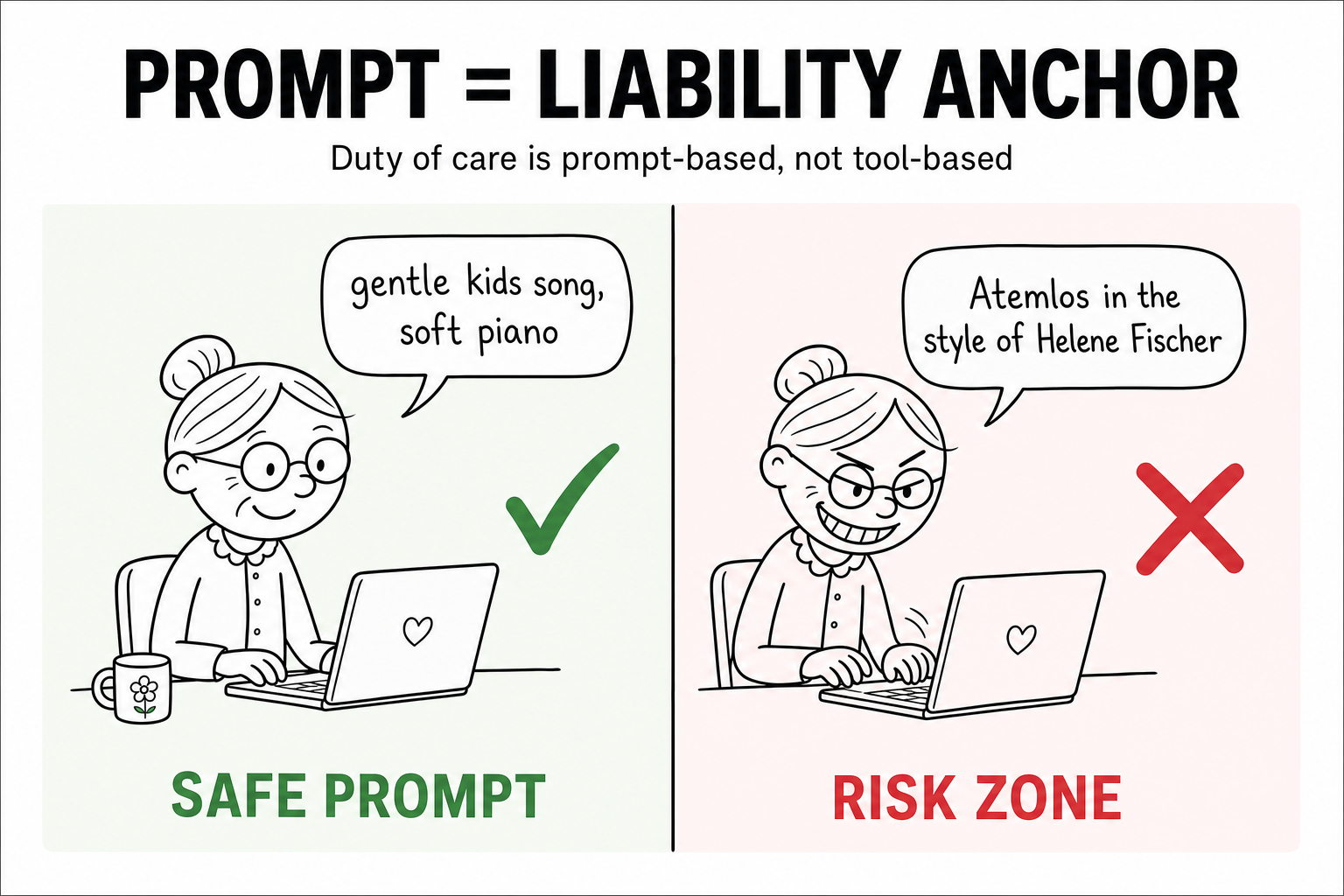
She uses Suno to generate a gentle children’s song for her grandchildren because one of them will not fall asleep, the booze is not working, and Grandma needs the benzos herself because Grandpa snores like a chainsaw in a horror movie.
And she does not do it once. She does it 20,000 times over the years. Either she has a lot of grandchildren, or the same grandchild secretly drops another ecstasy pill after every song.
Important: before the next clickbait clown immediately spray-painted “MILLIONS IN LIABILITY!!!” on the wall, those 20,000 songs are a wildly exaggerated hypothetical used to test the order of magnitude.
The question is as simple as it is toxic: is Grandma liable now? For 20,000 children’s songs? Because she used a tool in good faith?
Surely that cannot be right. You can practically hear Grandma shaking her head.
Brace yourself. I am leaving you dangling from the cliffhanger.
But I promise we will come back to Granny.
First, the law.
B) THE LAW
Disclaimer: I normally comment only on German law. This article does too—with one major exception, because the judgment itself crosses the Atlantic.
GEMA also asserted claims concerning reproductions made during training in the United States. Munich Regional Court I held that § 131(1) and (2) VGG gave it international jurisdiction over those claims. Under the lex loci protectionis principle, it then applied US copyright law to the US conduct—and rejected Suno’s fair-use defense. The acts in Germany were assessed under German law. So yes: in this case, a German civil court actually applied US law.
(LG Munich I, Press Release No. 16 of July 31, 2026—https://www.justiz.bayern.de/gerichte-und-behoerden/landgericht/muenchen-1/presse/2026/16.php—last visit: 2026-08-02 - 11:19)
1. THE RULING: WHAT MUNICH REGIONAL COURT DECIDED ON JULY 31, 2026
The 42nd Civil Chamber of Munich Regional Court I ruled against Suno on July 31, 2026 (Case No. 42 O 763/25—https://www.justiz.bayern.de/gerichte-und-behoerden/landgericht/muenchen-1/presse/2026/16.php—last visit: 2026–08–01–17:20). Before we classify anything legally, three coordinates need to be nailed down because the reporting loves throwing them into a blender.
And read the original source instead of the babble from people recycling hearsay and secondary reporting. For clarity, the linked source is the press release. A full-text judgment will appear at some point; once it does, look that up instead.
First, this is a civil copyright case, not a criminal prosecution. It concerns injunctions, damages, and disclosure. Nobody is charging you with a crime.
So put the soap back. You are not going to prison, bro.
Second: the ruling is against Suno as the platform operator, not its users. Lawyers call that inter partes
Call it a provider ruling if you like.
Third: based on what has been published so far, the judgment is not yet final, meaning it can still be challenged. And it will be. I would bet my sweet ass on it.
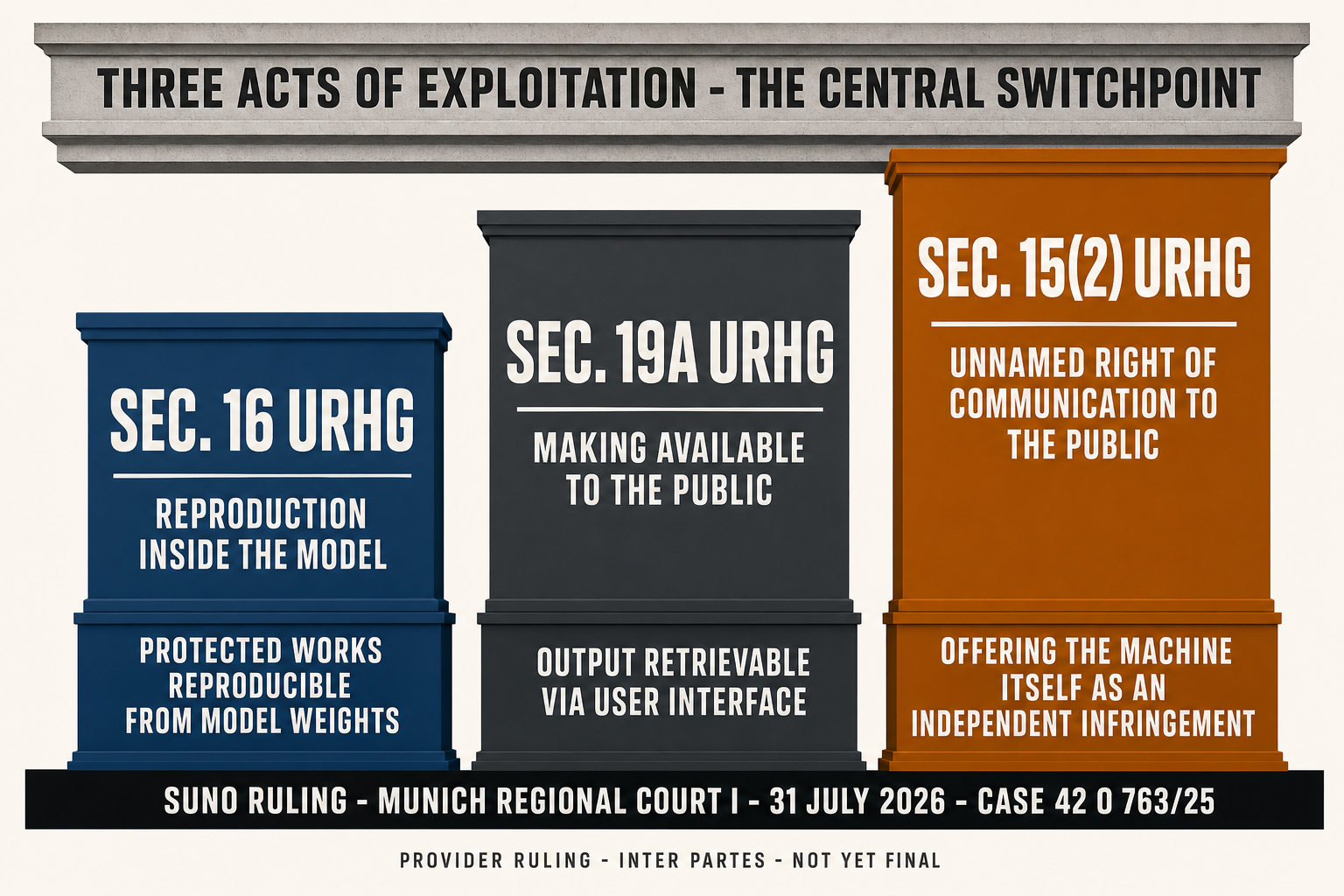
That matters:
Reproduction (§ 16 UrhG, the German Copyright Act) within the model because the six protected works at issue—Atemlos durch die Nacht, Rasputin, Big in Japan, Forever Young, the chorus of Mambo №5, and Daddy Cool—are “inside” the system in a form from which they can be reproducibly generated.
Communication to the public (§ 15(2) UrhG) in two distinct forms that must be kept separate:
a) Making available to the public (§ 19a UrhG) through the user interface when the reproduction is delivered on demand.
b) And—this is the bombshell nearly every secondary report left out—an unnamed right of communication to the public under § 15(2) UrhG was infringed by offering the model and generation application themselves. In other words, the infringement is not limited to the individual output. Making the machine available when protected outputs can fall out of that machine is itself the infringement. That is an independent second pillar of liability. If it survives in the full judgment, the implications for the entire GenAI music-provider industry are dramatic: providers are not liable only song by song but also for offering the platform.
§ 16 UrhG: reproduction is any fixation — including a transient one — that makes a work perceptible to the senses. The German Federal Court of Justice (BGH) has traditionally not been squeamish here. The Munich court’s point is this: if a work can be reproduced from the weight structure—the parameters that play the central role inside the neural network—that storage is treated as a reproduction.
§ 19a UrhG: making available “on demand” means users can access the work from a place and at a time of their choosing. Classic online exploitation.
§ 15(2) UrhG, unnamed right of communication to the public: the catch-all for forms of communication not specifically regulated elsewhere. As noted above, the Chamber focuses on the fact that merely keeping available a system capable of spitting out memorized works can interfere with that right.
This is the most dogmatically audacious move in the judgment, and it is what the appeal will revolve around. If you remember one legal point from this article, make it this one.
Why does § 44b UrhG not cure the problem?
So you are not left standing in the rain—or, worse, forced to look it up yourself; here is what § 44b UrhG does. It permits text and data mining: lawfully accessible works may be copied and processed for automated analysis but not retained as permanent storage or used for later communication. TDM copies are generally purpose-bound and must then be deleted, and for commercial TDM a rightsholder may reserve the use through an opt-out.
Two reasons it does not cure the problem:
The provision covers reproduction for analysis, not permanent reproducibility inside the model followed by later communication.
It effectively presupposes lawful access to the training data. Stream-ripping is not some permission-free procurement method that § 44b can elegantly bless after the fact.
A GLANCE ACROSS THE ATLANTIC: WHY FAIR USE FAILED
PROCEDURAL LEGALITY
US law was not a side note here. GEMA also asserted infringements arising from reproductions made during training in the United States.
How do they get to do that? German courts are not exactly famous for voluntarily dragging more work through their own doors—especially not work that tastes like US law.
The answer lies in a distinction that almost every secondary report throws into a blender: Who decides and which law applies are two completely different questions. Lawyers call them international jurisdiction and applicable law. Mix the two and you get mush.
First question: Why can a Munich Chamber rule on training copies made on servers in the United States?
Answer: § 131(1) and (2) VGG (https://www.gesetze-im-internet.de/vgg/__131.html — last visit: 2026-08-02 - 19:05).
This is not a “Munich reaches for world domination” move. It is a procedural rule with a built-in vacuum cleaner.
The provision gives collecting societies a privilege: a forum based on factual connection. In plain English: if GEMA sues the same defendant over several infringing acts, it may bundle the whole bouquet into one proceeding instead of hauling the circus around the globe five times.
And now comes the legal trick that usually burns out the clutch in secondary reports: the Chamber reads § 131 VGG—as it does many jurisdictional rules—as having a dual function. It asks not only, “Which court within Germany has jurisdiction?” but also, “May a German court hear the case at all, even though parts of it happened in the United States?”
In short: domestic allocation plus international reach.
That is the Chamber’s position, in condensed form, in the reasoning summarized by Munich Regional Court I (Press Release No. 16 — last visit: 2026-08-02 - 19:05).
And now the part almost nobody explains: once a court has international jurisdiction, it decides the entire dispute—including the pieces governed by foreign law. Adjudicatory power is the key term. The court may not split the case in half and throw the US half back across the Atlantic. It then determines foreign law ex officio (§ 293 ZPO — https://www.gesetze-im-internet.de/zpo/__293.html — last visit: 2026-08-02 - 19:05).
Honesty at this point: this international reading of § 131 VGG is open to attack. In practice, it creates a home-court forum for German collecting societies against providers from anywhere in the world. Conflict-of-laws scholars call that an exorbitant claimant forum (Conflict of Laws: Muscles from Munich? — last visit: 2026-08-02 - 19:05).
If Suno pulls a lever on appeal, this is one of them.
Second question: Why US law, then, instead of simply applying the UrhG to everything?
The lex loci protectionis principle, codified in Article 8(1) of the Rome II Regulation (EUR-Lex — last visit: 2026-08-02 - 19:05). Copyright does not exist as one body of world law. It is a patchwork of national rights: the law of each territory for which protection is claimed applies. The training took place in the United States → US copyright law governs those reproductions, including the fair-use analysis. Outputs and the offering of the service occurred—also—in Germany → the UrhG applies.
And no, this was not optional choreography by the Chamber. The Rome II Regulation applies universally (Article 3)—including where it points to the law of a non-EU country such as the United States—and for intellectual-property rights, a different choice of law is expressly barred (Article 8(3) Rome II). The Chamber simply had no choice.
That leaves one final question: Why can GEMA, of all entities, sue over US infringements? Because its members generally grant it their rights for all countries through its authorization agreement. It therefore showed up as the rightsholder for the US territory as well—not as a German authority playing world police. GEMA is not a public authority at all, by the way. It is a commercial association under state supervision.
The punchline: nobody grabbed powers that were not theirs. The legislature opened the door for GEMA through § 131 VGG, and conflict-of-laws rules put US law on the Chamber’s desk. No power grab. Just following the rulebook—with transatlantic reach.
SUBSTANTIVE LEGALITY
Jurisdiction: settled. Applicable law: settled.
That leaves the question on the merits: Was Suno allowed to do everything we are talking about here?
Suno’s answer: fair use.
But what is fair use?
Full disclosure: I delegated the research for this US-law subsection entirely to AI. I know German law; I do not know US copyright law. I can check what the Chamber says in its press release. But I cannot independently assess whether its application of US law is doctrinally correct. What follows is therefore a source-based account of the court’s reasoning—not my expert opinion on US law. I owe that much honesty to myself and, above all, to you.
The Chief AI Shaman from the introduction would have sold you a confident “US law? Easy!” at this point.
Fair use is a doctrine of US copyright law codified in 17 U.S.C. § 107. Brutally simplified: certain uses of protected works may be lawful even without permission. Four factors enter the ring: the purpose and character of the use, the nature of the protected work, the amount and substantiality of the portion used, and the effect on the potential market for the original work. None of the four wins by knockout on its own—the judges score the whole fight, weighing all factors together (U.S. Copyright Office: https://www.copyright.gov/fair-use/more-info.html — last visit: 2026-08-02 - 18:39).
The Chamber knocked out the defense. Relying on Andy Warhol Foundation v. Goldsmith (U.S. Supreme Court, May 18, 2023 — No. 21-869 — https://www.supremecourt.gov/opinions/22pdf/21-869_87ad.pdf — last visit: 2026-08-01 - 17:09), it concluded that every fair-use factor weighed against Suno (Munich Regional Court I, Press Release No. 16 — last visit: 2026-08-02 - 18:39).
Not close. Not three to one. Four–nil.
And now the question everyone following the US cases will ask: Why did Bartz v. Anthropic (decision — last visit: 2026-08-01 - 17:09) and Kadrey v. Meta (decision — last visit: 2026-08-01 - 17:09) make it through on fair use—but Suno did not?
We already dissected the answer in the technical section: there, the training data were not—or not substantially—accessible through the outputs. The book was in the library, but nobody could reach the shelf. Here, by contrast, even simple, open-ended prompts generated outputs substantially similar to the original works.
Memorization kills the transformation argument. If you spit the original back out, you are not transforming it. You are copying it by detour.
WHAT “NOT FINAL” ACTUALLY MEANS
One last pass without the fog, because secondary reports love using the phrase as decoration:
The judgment decides Suno’s provider liability for six works: reproductions during US training, reproductions in the models and outputs in Germany, communication of the outputs to the public and—separately—the offering of the model and application themselves. It does not decide the general liability of Suno users. Apparently I cannot chew that cud often enough.
And it is not final. Concretely, that means an appeal remains available—here, to the Munich Higher Regional Court (§§ 511 et seq. ZPO — https://www.gesetze-im-internet.de/zpo/__511.html — last visit: 2026-08-02 - 19:15). The deadline is one month after service of the full judgment (§ 517 ZPO). Only if that deadline expires unused or the appellate process has run its course is the thing carved in stone. Until then, it is a first-instance broadside. A loud one. But not the final word.
And the appeal will probably put exactly what we dissected above under PROCEDURAL LEGALITY back on the table: the conflict-of-laws/international-civil-procedure issue. The international reading of § 131 VGG is the judgment’s most exposed flank. If jurisdiction over the US conduct falls, the entire US-law portion falls with it—without any judge ever needing to talk about fair use again. Alongside it stands the dogmatically audacious second pillar for review: communication to the public under § 15(2) UrhG merely by keeping the service available.
Two exposed flanks. Suno will charge both. I would bet—you know what.
2. CONSEQUENCES FOR USERS
This section asks first whether you own rights in a Suno song, and then what rights other people might assert against you as a Suno user.
Let’s begin with copyright ownership: whether the song you roll out of Suno’s algorithmic dice cup actually “belongs” to you.
2A. COPYRIGHT IN GENERATED SONGS — WHAT CHANGES?
As a copyright matter, the Munich ruling is surprisingly irrelevant to what you “produce” as a Suno user. The reason is painfully simple: pressing a button is not authorship.
For the difference between a button-pusher and a hybrid musician like me, see my earlier article (https://medium.com/@wackyworld_jenshenneberg/using-suno-ai-legally-a-guide-to-copyright-and-ai-generated-music-in-2025-b4ddd77b4bce).
A copyright-protected work requires a personal intellectual creation with sufficient originality (§ 2(2) UrhG). If all you do is type a text prompt and let the machine do the rest, you lack creative control => design sovereignty. Even a “fucking awesome prompt” does not magically become composition.
The Munich Local Court worked through this cleanly in the image-AI context on February 13, 2026 (Case №142 C 9786/25—https://www.gesetze-bayern.de/Content/Pdf/Y-300-Z-BECKRS-B-2026-N-1513?all=False—last visit: 2026–08–01–17:10): a prompt must objectively and unambiguously shape the output in an identifiable way. Length by itself proves nothing. Even 1,700 characters were not enough because the specific creative imprint was missing. In legal terms, the lever is creative control.
Button-pusher (make a song for grandma, suno!)= no creative control = no authorship.
But the moment you contribute creative substance, the picture changes.
Your own lyrics: your own literary work (§ 2(1) no. 1 UrhG).
Your own rap or vocal performance over an AI instrumental: a performance protected by a related right (§ 73 UrhG).
The Frankfurt Regional Court expressly held in a Suno case on December 17, 2025, that human-written lyrics remain protected even if Suno sets them to music and AI tools later mess around with the text (Case №2–06 O 401/25 — https://www.rv.hessenrecht.hessen.de/bshe/document/LARE260000287 — last visit: 2026–08–01–17:11).
The text remains independently exploitable.
I can already hear the next question:
Great, my lyrics are protected. But what about the whole work, the finished song? Does the AI-generated music poison the entire thing?
Short answer: no. It poisons nothing. It simply contributes nothing. The song is not one indivisible work. It is a layer cake made from separate legal objects. Your lyrics remain your literary work. Your performance remains your performance. The AI instrumental is the unprotected filling in between. You hold no copyright in that layer, but it does not destroy the rights in yours either. The cake as a whole is protected only as far as your ingredients reach.
And before you ask, “So is the answer yes or no for the WHOLE song?”
For a hybrid musician: YES, in practice. Nobody can exploit your finished track without exploiting your lyrics and your voice along with it. That is where your rights bite.
If you copy the song, you infringe those rights. Period. The only part someone could theoretically slice out and reuse without infringing on your rights is the naked AI instrumental with you removed.
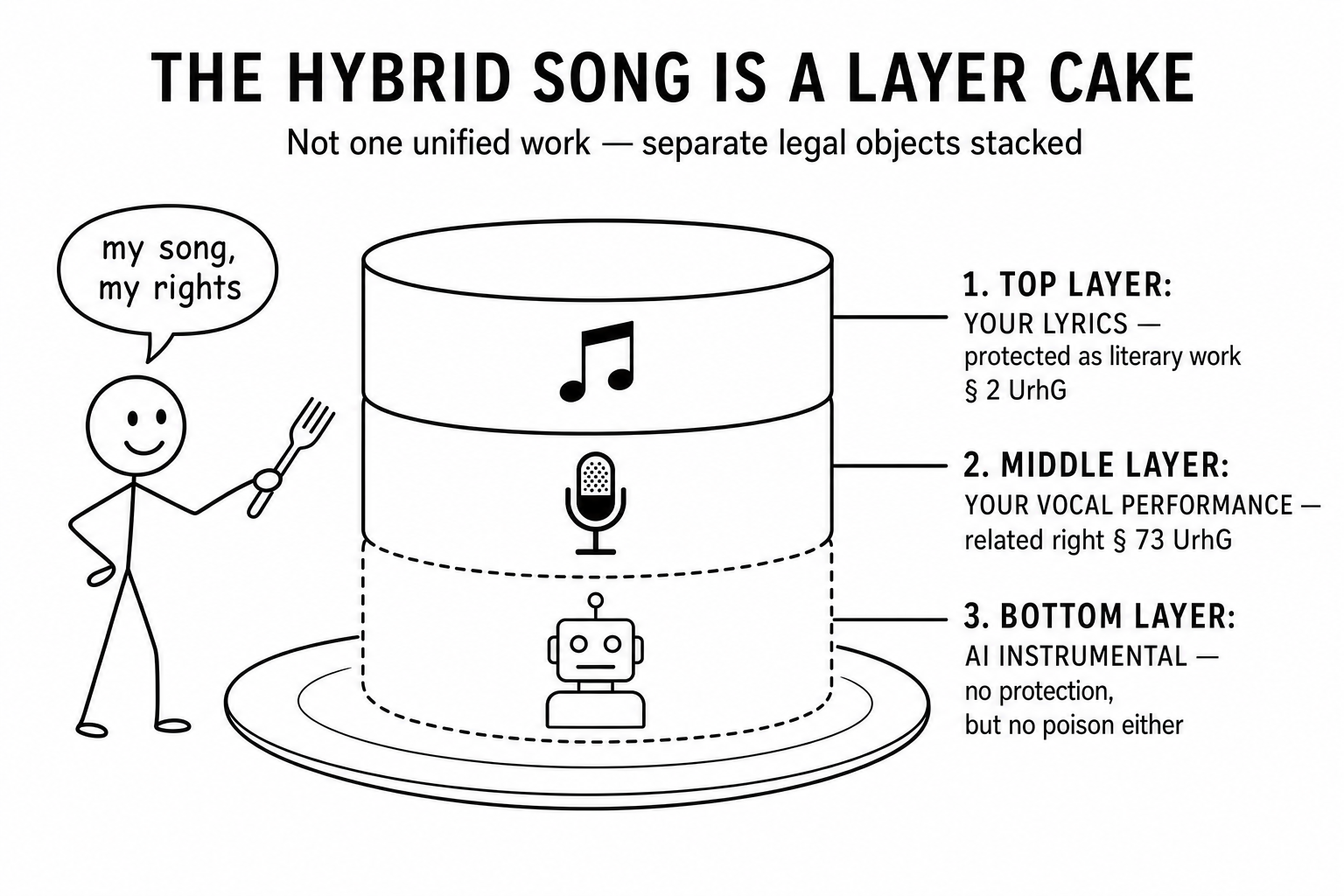
There is one exception where the music really does become poison: when the AI track contains a memorized third-party melody. Then a stranger’s right is embedded in the overall product, making the entire song vulnerable no matter how clean your lyrics are. We will get to that—and to why the custom-voice setup cuts this risk—in Section C.
2B. USER LIABILITY
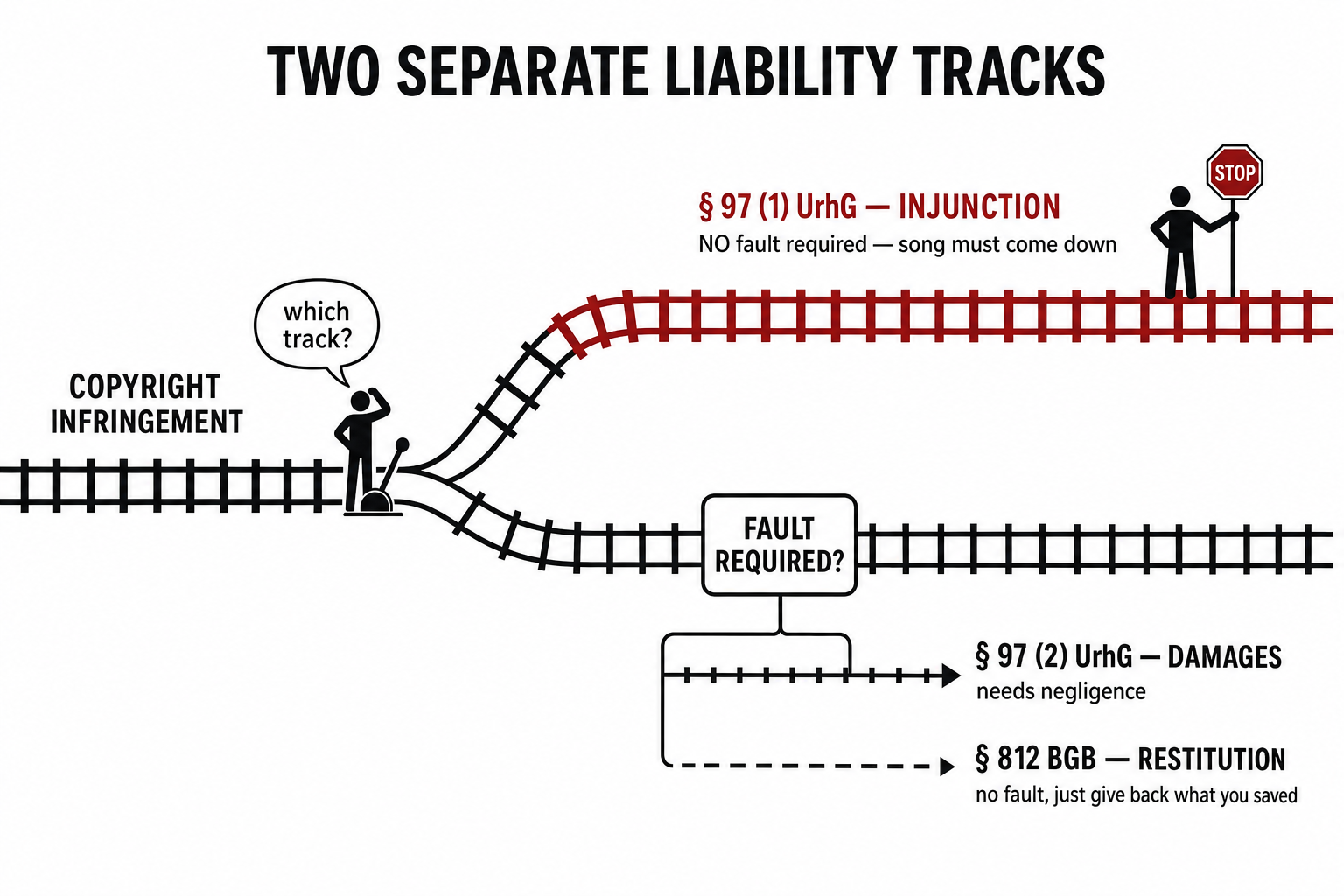
TRACK 1: INJUNCTIVE RELIEF (§ 97(1) URHG)
An injunction does not require fault. Meaning: guilt is irrelevant. Could the user have smelled the problem coming? Irrelevant. Did she want it? Irrelevant. One thing matters: an objective infringement.
It does not matter how carefully you worked. It does not matter whether you could possibly have recognized the match. That feels unfair, but in copyright law it is not a bug. It is the feature exclusive rights were designed to provide—just like property rights.
Concretely, if the generated song contains a memorized melody from a protected work and you publish the thing, the party is over. The track has to come down. Period. No less, but also no more. So we are not yet talking about damages. I’ll repeat it like a hook: injunction.
TRACK 2: DAMAGES (§ 97(2) URHG) AND RESTITUTION FOR UNJUST ENRICHMENT (§ 812 BGB)
These two causes of action run in parallel, and they tick in completely different ways.
Damages under § 97(2) UrhG are the “you were at fault” track. No fault, no damages. At least negligence under § 276 BGB must stick.
Unjust enrichment under § 812 BGB—specifically an interference-based restitution claim—is the “fault does not matter” track. You surrender what you actually obtained, generally the value of the license fee you saved. No punitive uplift. No fantasy damages.
Negligence determines the damages claim under § 97(2) of the UrhG. Injunctions, unjust-enrichment claims, and potentially the necessary cost of a justified cease-and-desist letter may still be on the table without fault.
THE NEGLIGENCE QUESTION: THE CORE
The central question is brutally simple: what level of care do you owe when messing around with generative music AI?
Every fault-based claim requires at least negligence.
My thesis for transferring general German negligence doctrine to GenAI music is this: the required care turns primarily on the concrete prompt, the recognizable output, and any warning signs — not merely on the use of the tool itself. There is no settled standard from Germany’s highest courts for the use of GenAI music yet.
Meaning: not “everyone who uses Suno is automatically negligent,” but if your prompt visibly marches into the legal minefield, duties start attaching themselves to your ass.
This is not some special AI doctrine. It is an old, musty internet-liability doctrine with a different coat of paint—subject to one important qualification. In Sommer unseres Lebens (German Federal Court of Justice, judgment of May 12, 2010 — I ZR 121/08 — https://juris.bundesgerichtshof.de/cgi-bin/bgh_notp/document.py?Art=en&Datum=2010&Gericht=bgh&Seite=37&Sort=1&anz=3026&pos=1122 — last visit: 2026–08–01–17:12), the BGH did impose a duty on the subscriber to secure a Wi-Fi router. The analogy to Suno is not one-to-one. It imports the same basic idea:
A duty of care where a recognizable danger exists, but attaches it to something else: not providing infrastructure, but drafting a prompt.
That matters because there is no blanket duty to “secure Suno,” neither for every user nor, under this analogy, automatically for the platform. The duty arises at the point where your prompt design starts firing visible red flares.
Two more BGH decisions sketch the contours:
Kinderhochstühle im Internet (BGH, judgment of July 22, 2010 — I ZR 139/08 — https://juris.bundesgerichtshof.de/cgi-bin/rechtsprechung/document.py?Art=en&Blank=1.pdf&Datum=2011-2-1&Gericht=bgh&anz=17&nr=55054&pos=12 — last visit: 2026–08–01–17:13): duties are capped at what is reasonable.
BearShare (BGH, judgment of January 8, 2014 — I ZR 169/12 — https://juris.bundesgerichtshof.de/cgi-bin/rechtsprechung/document.py?Art=en&Gericht=bgh&anz=1&nr=67883&pos=0 — last visit: 2026–08–01–17:13): Attribution requires a concretely attributable infringement.
The common thread: duties are concrete and triggered by circumstances, not abstract. The tool is not “evil.” Your conduct is the point of attachment.
Applied to Suno, “gentle children’s song, piano” belongs to a different universe from “Make me a lullaby in the style of Helene Fischer’s Atemlos”
MELODY COPYING: KNOWLEDGE AND RECOGNIZABILITY
Two more decisions from Germany’s highest civil court sharpen that attribution point for copied melodies.
First, Magdalenenarie (BGH, judgment of June 5, 1970 — I ZR 44/68, GRUR 1971, 266 — https://bpb-us-w2.wpmucdn.com/blogs.law.gwu.edu/dist/a/4/files/2020/08/BGH-Decision_I-ZR-44_68-German.pdf — last visit: 2026–08–01–17:14).
The First Civil Senate makes the point that an objectively copied melody is not enough for an attributable taking. The later creator must also know the older work and consciously draw on it.
Second, Beatles-Doppel-CD (BGH, judgment of December 18, 1997—I ZR 79/95, GRUR 1998, 568—https://www.anwalt24.de/browse/document/2c1df64c-1e99-4085-95a4-aa12ee519d09—last visit: 2026–08–01–17:15).
Here, the BGH draws the boundary of reasonable care through recognizability: duties hit the user where she is recognizably operating in a legal gray zone.
Not everywhere. Not in the abstract. Exactly where an ordinary person realizes, “Okay, now this is getting copyright-hot.”
THE REASONABLENESS LIMIT: WHAT CHECKS CAN ANYONE ACTUALLY EXPECT FROM YOU?
The reasonableness limit is where comment sections expose themselves with extraordinary efficiency: “Then Suno users should just run every track through Shazam before uploading it!”
Sounds like a “simple solution,” but legally and technically it is about as robust as an umbrella in an MMA cage. I know what I’m talking about; I’ve practiced martial arts for more than thirty years.
Yes, audio fingerprinting exists: Shazam, ACRCloud, and similar tools. But it primarily detects recording identity: the same recording
If a memorized melody comes back with different instrumentation, in a different key, over a different beat and mix, fingerprinting often shrugs and says, “Never heard of it.”
Meaning: You cannot impose a duty to perform a check that begins with the wrong measuring instrument. The duty cannot plausibly extend as far as people in this debate like to claim.
THE GRANDMA TEST: THE ANSWER
Back to Grandma. The interim legal result feels ugly, but it is honest.
If Grandma publishes the song—rather than merely playing it on her phone, dumping it on a platform, or sharing it publicly—and the thing contains a memorized third-party melody, the rightsholder can seek an injunction.
Meaning: take the track down. Period.
And yes, a restitution claim for the value of the saved license fee may also apply. Fault does not matter.
That is the hard truth. It feels wrong and is still legally correct. Grandma’s intuition — understandable head-shaking included — is not the legal standard. Liability remains, at least for an injunction and restitution of enrichment.
COMFORTING AND SOBERING NEWS
Let’s start with the relief, and it is substantial:
First: for the decent user, a damages claim — not an injunction — under § 97(2) UrhG fails, at least on a defensible reading, at the negligence threshold. Someone who prompts “gentle children’s song, piano” is not recognizably operating in a gray zone within the logic of the Beatles Doppel-CD. Full damages therefore fall away. We covered that at length a few paragraphs ago.
So, summarizing AI, kindly scroll your ass back up. Small dose of honesty: Germany’s highest courts have not finally settled the standard of care for GenAI music use. I defend this position for solid reasons. Nobody can guarantee it. Anyone who promises otherwise is lying or does not understand the problem.
The amount of money at stake cannot currently be reduced to a responsible flat figure.
It depends, among other things, on the type of use, reach, duration, monetization, and the fee reasonable contracting parties would have agreed upon for that exact use. Filesharing case law cannot be transplanted mechanically onto AI-generated music. The circulating millions-in-liability figures are therefore just as unserious as blanket reassurances.
Second. Financial hardship on the infringer’s side offers only limited help in German copyright law. The BGH has repeatedly said so in photo-license cases, notably Restwertbörse I (BGH, judgment of April 29, 2010—I ZR 68/08 = GRUR 2010, 623—https://juris.bundesgerichtshof.de/cgi-bin/rechtsprechung/document.py?Art=en&Gericht=bgh&anz=1&nr=52373&pos=0—last visit: 2026–08–01–17:16), involving photographs taken by a vehicle-damage assessor that HUK-Coburg uploaded to an online residual-value exchange without permission, and Sportwagenfoto (BGH, judgment of September 13, 2018 — I ZR 187/17 — https://juris.bundesgerichtshof.de/cgi-bin/rechtsprechung/document.py?Art=en&Gericht=bgh&az=I+ZR+187%2F17&nr=90839—last visit: 2026–08–01–17:16), where the court accepted EUR 100 in license-analogy damages for a simple photograph.
The common thread: the amount turns on the objective value of the infringing use, not subjective fault or the infringer’s financial condition. Remember: you are expected to have the money. Otherwise, everyone could snort and drink away every profit and then stroll out of liability whistling.
To inject some philosophy:
“I spent a lot of money on booze, birds, and fast cars. The rest I just squandered.”
George Best, Northern Irish footballer, 1946–2005
Third, and this is the real insolvency-law anchor: if you genuinely run out of money, the key problem is not “how high is the claim?” It is § 302 of the German Insolvency Code (InsO). That provision excludes liabilities arising from intentional torts from discharge in consumer insolvency. Meaning: If a copyright infringement is established as an intentional tort and filed in the insolvency proceeding on that basis, it sticks to you like gum under a table even after the proceeding ends. Other insolvency claims have long since vanished into the void.
Section 302 InsO does not catch decent Grandma because she lacks intent. The guy who deliberately uses targeted prompts to coax protected works out of the model and then pretends it was “random”? It catches him. That is exactly what the rule is for.
2C. RECOURSE AGAINST SUNO — THE SHORT VERSION
For completeness, because this question may still look like a life raft to anyone with a giant glowing “P” for “PANIC” in their eyes:
Could a user seek recourse from Suno if the shit hits the fan? Possibly. But only if you fit inside the consumer box—see §§ 13 and 14 BGB, the German Civil Code.
Now for honesty instead of marketing sludge: a recourse chain against a US provider is not automatic. It is a legal minefield of its own. Here is the short statutory map so you know where you are stepping.
§ 327g BGB governs legal defects in digital products. A digital product is free from legal defects if you can use it in accordance with the contractual and objectively expected requirements without infringing third-party rights. If a Suno output demonstrably infringes someone else’s rights, you could argue that this is precisely such a defect. The consumer’s actual remedies—cure, termination, price reduction, and damages—appear in §§ 327i et seq. BGB, not in § 327g itself.
Section 327s(4) BGB exempts limitations of liability from the special no-derogation rule in subsections 1 and 2. But those clauses remain subject in particular to general German standard-terms law under §§ 307–309 BGB and to other mandatory limits on liability.
The full business-to-business recourse mechanism between a retailer and an upstream supplier is set out in § 327u BGB. At the end-consumer level, though, that is secondary.
And before someone shits “HAHA, THEN MAKE SUNO PAY!!!” into the comments again: an explosion somewhere does not automatically hand you Hollywood damages and a fat check. You get only what the law provides in your factual constellation, what the terms leave available, and what you can actually enforce against a provider probably sitting in Boston.
Whether a user qualifies as a consumer depends on the predominant purpose of the contract when it was concluded. It does not automatically change because she monetizes a few songs later.
The punchline in one sentence: Frankfurt wins, Boston loses.
Meaning: Under German consumer and digital-products law— Frankfurt—you have a doctrinal foothold against the provider: a legal defect in the digital product, therefore potential recourse. Under typical US deals and terms of service in Boston, the answer is more likely “your problem”: liability exclusion, arbitration, and you are the one left holding the leash.
That is not a footnote. It is the difference between “I can fight back” and “I can only pay.”
Separate chapter, separate article. The follow-up is in the works.
C) PRACTICAL CHECK: WHAT DOES THIS ACTUALLY MEAN FOR GRANDMA—AND FOR MUSICIANS LIKE US WHO USE AI?
Now we turn the grandma answer into something musicians can use.
THE CUSTOM-VOICE SETUP
If you use Suno the way I do—my own voice, my own lyrics, and Suno only as the musical scaffolding—you are reducing risk, not eliminating it. Anyone promising otherwise is selling you a sedative, not a legal opinion. But the difference from the button-pusher setup is substantial, which is exactly why the technical section above was not nerd foreplay. It was the reasoning.
The custom-voice setup reduces several known trigger channels, but it cannot reliably exclude reproduction of protected works.
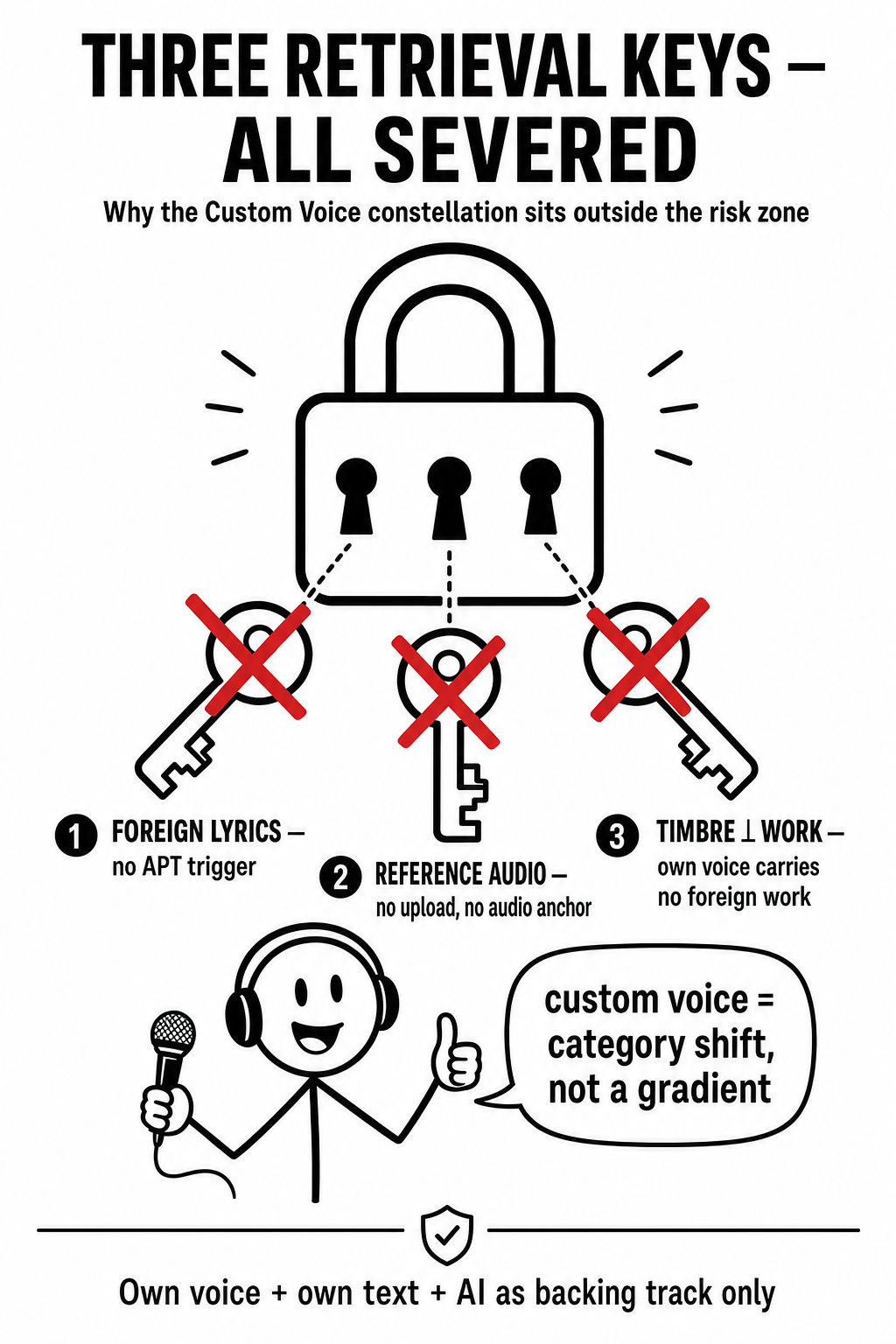
- No third-party lyrics trigger: no APT effect because the lyrics are yours. You are not inserting a canonical key into the lock.
- No audio anchor: no reference-audio upload, so no “here, eat this original and spit it back out at me.” If you upload a slightly altered Rammstein song — easily done with any number of audio VSTs that granularize audio or beats — then you should not merely be ashamed of yourself. You are fully liable. And rightly so!
- Your own voice is not an element of the musical work: just because it sounds like you does not make it the work. Timbre is tone color. It belongs to the human forcing air through their larynx, not to the protected song.
Technically, that is not just “how it feels.” It is standard in signal processing and voice conversion research: vocal features are considered separately as timbre, pitch, and content (foundational: https://arxiv.org/abs/2012.01837 visit: 2026–08–01–12:07). Timbre is specifically not melody, not composition, and not the protected element of a work. Timbre by itself is therefore not a “work” within § 2 UrhG either.
Important, before someone misunderstands me: that helps you under copyright law. It does not protect you from personality rights under § 823(1) BGB or Germany’s Art. Copyright Act, the KUG. Those are different construction sites. Clone the voice of a real person, and you have another problem—just not one created by the Suno ruling.
And the legal bridge here is not “Trust me, bro,” but case law. The Frankfurt Regional Court held on December 17, 2025 (Case №2–06 O 401/25 — https://www.rv.hessenrecht.hessen.de/bshe/document/LARE260000287 — last visit: 2026–08–01–17:17) that a person’s own lyrics remain independently exploitable in a Suno setup. That is the hinge for custom-voice practice.
You contribute the protectable substance—lyrics and, where applicable, performance—while Suno supplies the scaffolding. It is not the author.
THE RED LINES
The custom-voice setup is risk-reduced, not risk-free. There are three traps you need to know.
Artist names can substantially strengthen stylistic steering in a music model. The Name-Free Gap paper demonstrated that effect for MusicGen-small (arXiv:2509.00654—https://arxiv.org/abs/2509.00654—last visit: 2026–08–01–17:18). That supports an increased imitation risk, but it does not demonstrate extraction of memorized works from Suno.
Second: canonical third-party lines in the lyrics. Even if the rest of the text is original, quoting one line from a well-known song in the chorus can be enough to trigger the memorized work through the APT effect. Anyone writing their own lyrics should know that trap exists.
Third: reference audio and stem uploads. In certain modes, Suno allows reference audio or individual instrument tracks—stems—to be uploaded. Upload someone else’s material and you open a direct audio anchor into a memorized work. Avoid this feature consistently in a custom-voice workflow. Yes, I mentioned it already, but repeated lashes speed the healing. Old galley wisdom.
EU law adds another boundary relevant to ambitious exercises in style. In its judgment of April 14, 2026 (Case C-590/23, Pelham II — https://curia.europa.eu/site/upload/docs/application/pdf/2026-04/cp260050de.pdf — last visit: 2026–08–01–12:12), the Court of Justice of the European Union held that the pastiche exception does not cover concealed imitation. A commercial-style clone does not receive a free pass merely because someone slaps the word “pastiche” on it.
STYLE IS FREE; the work is not.
If I build a song that smells like Viking metal—the Sabaton/Amon Amarth idiom—am I infringing copyright?
The legal answer is about as sexy as an internal memo, but crystal clear: no, as long as you genuinely imitate only the style.
Style is free. The legislature does not protect an “atmosphere,” “vibes,” or a “Vikings in the fog” aesthetic. It protects the work: the concrete intellectual creation. Meaning the melody, a distinctive motif, a memorable hook, a lyric, or a riff in its concrete form.
That is not a gut-feeling argument. It is the line drawn by the case law: in music, Dirlada (BGH, judgment of September 26, 1980—I ZR 17/78, GRUR 1981, 267—https://www.anwalt24.de/urteile/bgh/1980-09-26/i-zr-17_78—last visit: 2026–08–01–17:19); and in other forms of protection, Porsche 911 (BGH, judgment of April 7, 2022—I ZR 222/20, GRUR 2022, 899—https://juris.bundesgerichtshof.de/cgi-bin/rechtsprechung/document.py?Art=en&Datum=2022-4&Gericht=bgh&Seite=5&anz=228&client=12&pos=178 — last visit: 2026–08–01–17:19) and USM Haller II (BGH, judgment of July 2, 2026 — I ZR 96/22 — https://rewis.io/urteile/urteil/hok-02-07-2026-i-zr-9622/ — last visit: 2026–08–01–17:19). Across those contexts, the dividing line remains: style ≠ work.
In plain English:
“Sounds like Sabaton”: irrelevant under copyright law.
“Takes the melody from Bismarck”: welcome to Magdalenenarie and the question of copying a protected work.
The difference is brutally simple: are you taking a concrete creative form or only the stylistic idiom of a genre?
OLD TRACKS: WHAT HAPPENS TO SONGS I ALREADY RELEASED IF THE RULES CHANGE NOW?
If you have released Suno tracks over the years and are now getting nervous, a later licensing deal does not automatically cure earlier uses. The parties can, however, expressly grant retroactive rights, approvals, or settlement effects.
For copyright claims based on unjust enrichment, the limitation period follows § 102 sentence 2 UrhG in conjunction with § 852 BGB: ten years from the claim’s accrual, subject to an ultimate thirty-year period from the act.
An honest audit of your back catalog is worth doing.
The operative word, by the way, is “honest.”
SUMMARY
The Munich Regional Court I judgment of July 31, 2026 (Case No. 42 O 763/25—https://www.justiz.bayern.de/gerichte-und-behoerden/landgericht/muenchen-1/presse/2026/16.php—last visit: 2026-08-02 - 19:05) is a non-final provider ruling spanning two legal systems. For reproductions made during training in the United States, the Chamber held that § 131(1) and (2) VGG gave it international jurisdiction, applied US law under the lex loci protectionis principle, and rejected Suno’s fair-use defense. For the conduct in Germany, it found reproduction in the models and outputs (§ 16 UrhG), making the outputs available to the public (§ 19a UrhG), and—separately—communication to the public through the offering of the model and application themselves (§ 15(2) UrhG).
The judgment decides Suno’s provider liability for six works. It does not decide the general liability of Suno users. Two exposed appellate flanks remain: the international reach of § 131 VGG and the § 15(2) theory based on merely keeping the service available.
Injunctions, the cost of justified cease-and-desist letters, and unjust-enrichment claims can arise without fault. Their economic value depends on the concrete use and cannot currently be stated as a universal figure.
Anyone using Suno with their own voice, their own lyrics, and no reference audio—the custom-voice setup—operates with reduced risk, not zero risk. Three red lines require strict attention: artist names in prompts, canonical third-party lyrics, and stem uploads.
What is on trial is not the tool in the user’s hand, but the business model behind the tool.
No grandstanding. No panic. No gloating.
But a metric fuck-ton of rage at the idiots who think they can squeeze ten years of legal training, another ten years of computer science, and twenty years of professional experience out of an AI like toothpaste from a tube. Shut your mouths when you do not know what you are talking about, because the old rule still applies:
A fool with a tool—AI included—is still a fool.
Further reading on ki-codex.ai: the series on copyright in AI-generated works and the button-pusher question; the earlier article on creative control following Munich Local Court Case No. 142 C 9786/25; and the forthcoming follow-up on the transatlantic asymmetry between German digital-products law and US deals.
About the author: Jens Henneberg is a lawyer and computer scientist. He leads major AI projects, currently at an international law firm; previously worked as a cloud solution architect at Microsoft; advises on the EU AI Act; and produces music as MC Henne (rap), ShimGor (synth pop, with his nephew), and Necrotic Awakening (death metal).