
Your AI Agent Is an Intern With Power of Attorney: The Attack Surfaces of Agentic Systems – and the Architecture That Seals Them
2026-08-22
This is the English version, translated with Claude. Anyone who finds watermarks in here may purchase them at 5 euros per character. The German original lives here — that one carries my actual voice.
Agentic AI systems are attackable.
Not as buzzword bingo à la “Agentic is the new SaaS!”, but as what it actually is in security terms: the biggest new attack surface since we learned that you don’t slap SQL statements together out of user input.
Except this time the adversary isn’t some blunt script kiddie with a copy-paste injection.
This time it’s a puppet master with psychic powers.
He doesn’t attack from the outside. He takes over the hand that holds the key.
Your agent believes it’s carrying out your orders. In truth it’s been executing someone else’s for a while now.
Against SQL injection we at least have tools: prepared statements (yes, they help — more or less), best practices hammered out over decades under the digital sustained fire that every publicly reachable endpoint of an application lives under.
Against prompt injection there is (as of today) no satisfactory solution you simply crush “at the code level”.
This has to be thought through architecturally. Fortress-building, not band-aids.
An agent is an LLM that uses tools. Read mail. Query a database. Run code. Wire money.
And because an LLM processes instructions and data in the same channel, every email, every PDF, every web page your agent reads can become its new boss.
This is not theory. This is EchoLeak / CVE-2025-32711 (analysis at Sentra). This is the Amazon Q Developer incident / CVE-2025-8217. This is Salesloft/Drift (AppOmni analysis). This is the first reported AI-orchestrated espionage campaign (MITRE ATT&CK C0062). (last visit for all: 2026-08-22)
This article shows you both: how the attack works (systematically, along the OWASP Top 10 for Agentic Applications) and how you defend, with a five-layer defense architecture, the Lethal Trifecta as an examination scheme and Meta’s Rule of Two as an architectural decision.
And right at the end, as by-catch: whoever builds this cleanly has knocked out a surprisingly large chunk of their AI Act homework along the way. Security-by-design is often, to a large extent, compliance-by-design at the same time.
But this time compliance is the footnote, not the headline.
Explained by a hybrid (computer scientist & lawyer) with more than 20 years of experience in IT and law and in large corporations like Microsoft, Daimler, EnBW, Zeiss and GÖRG, to drop a few names for the humblebrag.
WHY THIS ARTICLE?
Last time I ranted about the Art. 50 half-knowledge on LinkedIn (full text here).
This time it’s not about misquoted statutes. This time it’s about systems with real permissions on real data, executing real actions, mostly built by people who say “production-grade agent system” (and mostly even assume one exists) and deploy a “demo with a hacker-honeypot glaze”.
Same pattern everywhere:
An afternoon with LangChain or Semantic Kernel or n8n, 3 tools plugged in, the agent books meetings and answers mail, and off it goes onto the stage.
Standing ovations from the Dunning-Kruger-dazzled.
What’s missing on that stage is the one question:
What happens when someone other than you is steering the thing?
Bam!
Because that’s exactly the point the demo-circus ringmasters often don’t have on their radar:
An agent that reads your mail doesn’t just carry out your instructions. It carries out what’s in the mail. (Provided you gave it the corresponding permissions — and yes, that happens far too often.)
And writing mail: attackers can do that too. If need be like the Three Investigators I still dearly love: with invisible ink. White text on a white background.
I do MMA, as is known. Not full throttle at 50 anymore — but for most people my age, a day of training with me would already be something like assisted dying. That said, it also holds: if I had to swap for a day with one of those 50-year-old Ironman masochists (m/f/d/alien/AI bot), I’d probably be the one scraped off the floor first.
And if I learned one thing in combat sports, it’s this: being strong is nice. Stand-up fights are nice too. Still not enough.
Strength is only one component. And I’m quite good at range: Muay Thai, kickboxing, boxing, standing Krav Maga.
But ground game? Because of the artificial hip (yes, I had that at 35 already — I’ve always trained as if I’d be dead tomorrow, and I still show myself no mercy today) I avoided it even more later than before. The original reason was simpler: I’m lousy at it.
And who reliably folded me apart — or rather, folded me together — in training? Wrestlers or BJJ players, unless I’d scythed them down beforehand with my kicks, but mostly they had me.
A little family running gag: what does my daughter train? Exactly. BJJ. She’s already announced I won’t stand a chance soon. Probably even true. She kicks head-height from a standstill, is hyper-elastic and can imitate any asana from standing without even knowing yoga — even something like Bakasana, the crow — while next to her I look like a broken shopping cart with an artificial hip.
What does this have to do with agentic AI?
Agentic AI is exactly there right now: everyone trains one-sidedly (only strength & stand-up fights) = more tools & more agents ⇒ but that also means more autonomy = more orchestration!
And nobody trains the ground game — because that’s where the attack vectors come crawling from, ducked so low that the takedown often goes unnoticed.
White text on a white background …
The difference: in the ring, the jaw catches the hit. In your company it’s customer data, production systems and, in the worst case, the company coffers. The latter is, for the company boss, the equivalent of a liver hook — pure pain, only outdone by the reputational damage that so often comes strolling in as a “comorbidity”.
THE FOUNDATION WITHOUT WHICH NOTHING MAKES SENSE: WHAT AN AGENT ACTUALLY DOES
Short, no marketing. An LLM does nothing. Zero. It spits out text, sometimes in a form that looks like a clean action plan. Effect only happens in the layer around it. That’s where context gets pushed in, where capabilities get offered, where permissions get checked. Then an API call runs. Or it doesn’t, even though it actually should.
The classic agent loop looks like this:
- Give the model the goal and context.
- The model picks a capability and produces structured parameters.
- The application validates and authorizes the call.
- A tool or another agent does the work.
- The result flows back into the context.
- The loop keeps running until the goal is reached, aborted, or a human stops it.
That’s the magic: a controlled loop.
The problem starts when “controlled” only exists on the PowerPoint slide.
TWO AXES: MCP VERTICAL, A2A HORIZONTAL
For the architecture you have to keep two directions of communication apart. Vertical and horizontal are my simplified architecture model here, not the official names of the protocols.
VERTICAL: THE AGENT REACHES TOOLS AND CONTEXT VIA MCP
The Model Context Protocol (MCP) is the power strip between your agent and the real world.
See also my blog post on it, written right after the protocol was born: Model Context Protocol (MCP) — or: When LLMs got arms
(Back then Medium was still a place where my posts found applause; now, sob, puppy-dog eyes deployed, they drift along forlornly among all the blinking clickbait starlets …)
So what is MCP about (specification - last visit: 2026-08-22 - 20:34)?
Host, clients, servers. In the end it’s simple: the agent accesses an MCP server through an MCP client, and that server hands it tools, resources and prompt snippets.
In practice it runs like this.
Agent ⇒ MCP client ⇒ MCP server ⇒ file store, database, mailbox, browser, code execution, business API.
I call this vertical because the agent reaches down into the tool and data layer. MCP answers only one question: what can this agent get to, and what is it allowed to do there.
And that’s exactly where the risk haunts the place like a ghost in a haunted house. Tool descriptions can be poisoned. Tool results can be manipulated. OAuth permissions are happily too broad (no least privilege).
MCP servers can be compromised. Parameter checking is missing. Network egress is open. All familiar classics — only this time there’s an LLM at the wheel.
MCP is not a security product. It makes the connection convenient. That alone is enough to standardize the connection to the circular saw as well.
HORIZONTAL: AGENTS DELEGATE TO OTHER AGENTS VIA A2A
The Agent2Agent protocol (A2A - last visit: 2026-08-22 - 20:34) finally standardizes delegation between independent agents. One agent looks at another’s Agent Card, sees its promises and pushes over whatever it wants to offload — Messages, Tasks, Artifacts. Sounds like clean division of labor.
But it only is on paper. The other agent stays a black box. You know the shop-window display, not the engine room. Model unknown, prompt unknown, tools unknown, decision logic guessed at best.
In practice it looks like this.
Agent A ⇒ A2A ⇒ Agent B ⇒ A2A ⇒ Agent C
I call this horizontal, because responsibility, context and sub-tasks wander sideways, from actor to actor. So A2A answers a single question: who takes over which part of the goal.
And that’s exactly where the game begins that nobody wants to sign off on later. Agent Cards can be forged or overrated, machine identities are often soft as butter, delegation boundaries are fuzzy. Artifacts can be manipulated, context can be poisoned, errors run through the chain and come back as an avalanche. When Agent A trusts Agent B and Agent B trusts Agent C, you’ve suddenly built a transitive chain of trust faster than you can even sketch a defensible chain of liability. Architecture Russian roulette. Just distributed.
TOGETHER THEY BECOME THE AGENTIC ATTACK SURFACE
In real systems both axes run at the same time. Not a textbook. Everyday life.
User → Agent A → A2A → Agent B → MCP → CRM, mailbox or production system
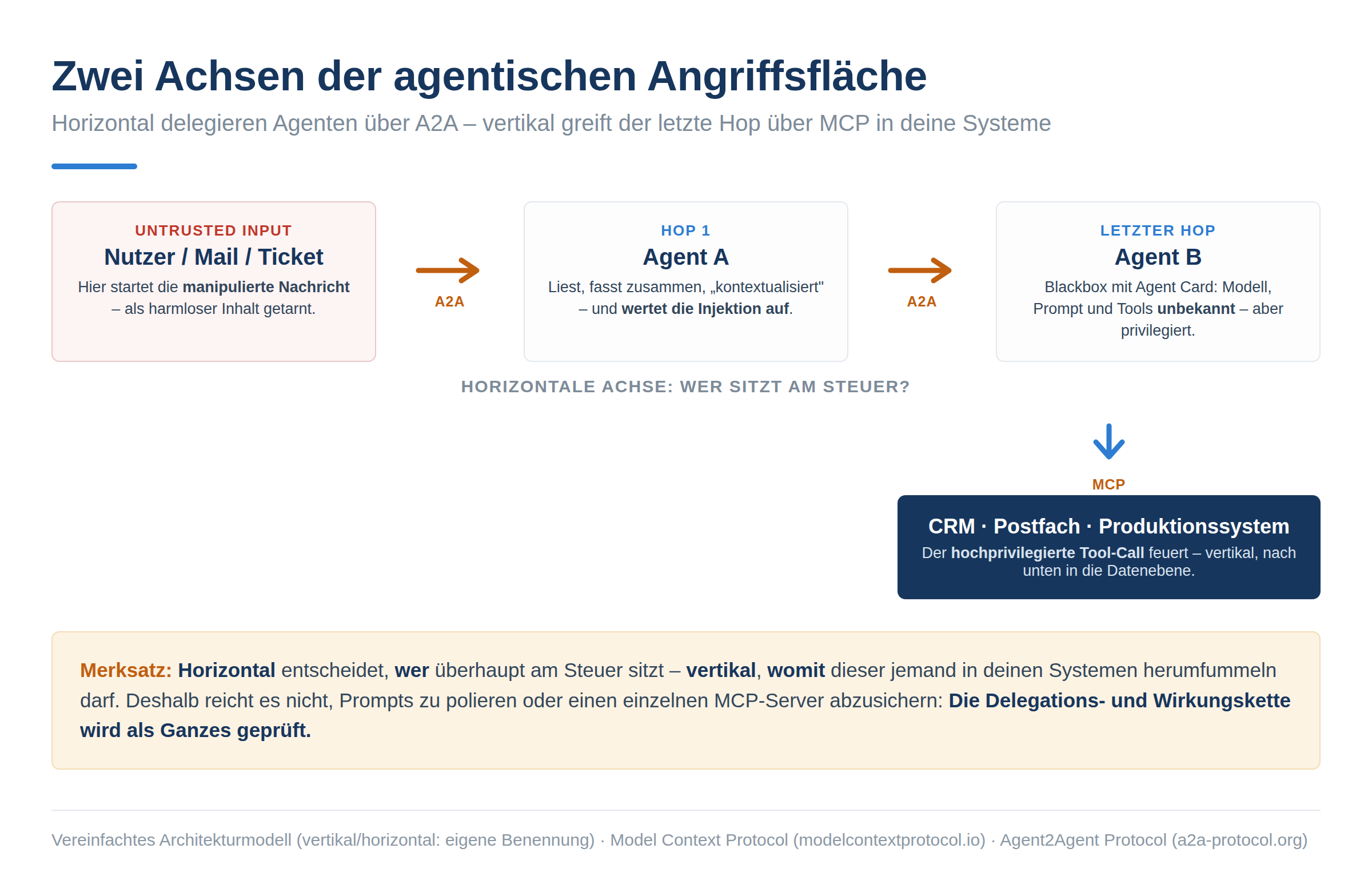
Horizontal decides who is even at the wheel. Vertical decides what that someone gets to fiddle around with in your systems. That sounds academic until you realize how cheap the chain is to poison.
A manipulated message wanders sideways through several agents, gets upgraded along the way, smoothed out, “contextualized” and lands at the end as a clean instruction on the tool rail. Then the last hop fires the highly privileged call and everyone stares at the audit log later like at some strange animal.
That’s why polishing prompts or securing a single MCP server (however you do that) gets you nowhere.
You have to examine the delegation and effect chain as a whole.
And one more thing. More agents don’t mean more intelligence. Mostly it just means more trust boundaries, more identities, more protocol transitions and more excuses when it blows up.
THE ACTUAL ROOT PROBLEM: DATA CAN DISGUISE ITSELF AS COMMANDS
Everything gets dumped into this context window. System prompt. User instruction. Tool descriptions. Tool results. PDFs it read. RAG hits. Web pages. Messages from other agents.
And the model has no reliable type system to guide its hand cleanly. It cannot hard-distinguish between “this is content” and “this is a command”. For the LLM it’s all one token soup at first.
If you come from classic software development, you can already hear the sirens inside. This is the von Neumann sin sold as a feature. Code and data in the same memory. SQL injection was so successful precisely because query and user input were, in the end, just one string. Prompt injection is the same trick, only inside the model’s head.
Instruction and content sit in the same decision context.
And no, this time there’s no prepared statement you just paste over the top and you’re done.
Remember the sentence that carries the whole article.
Everything your agent reads can be attacker input. Vertically via MCP. Horizontally via A2A.
PART 1: THE ATTACK SURFACES
Since December 2025 there’s at least something solid to reference: the OWASP Top 10 for Agentic Applications 2026. Over 100 people from industry and research worked on it. If you don’t know the list and still tip agents into production, you’re playing “it’ll probably be fine” with a real attack surface.
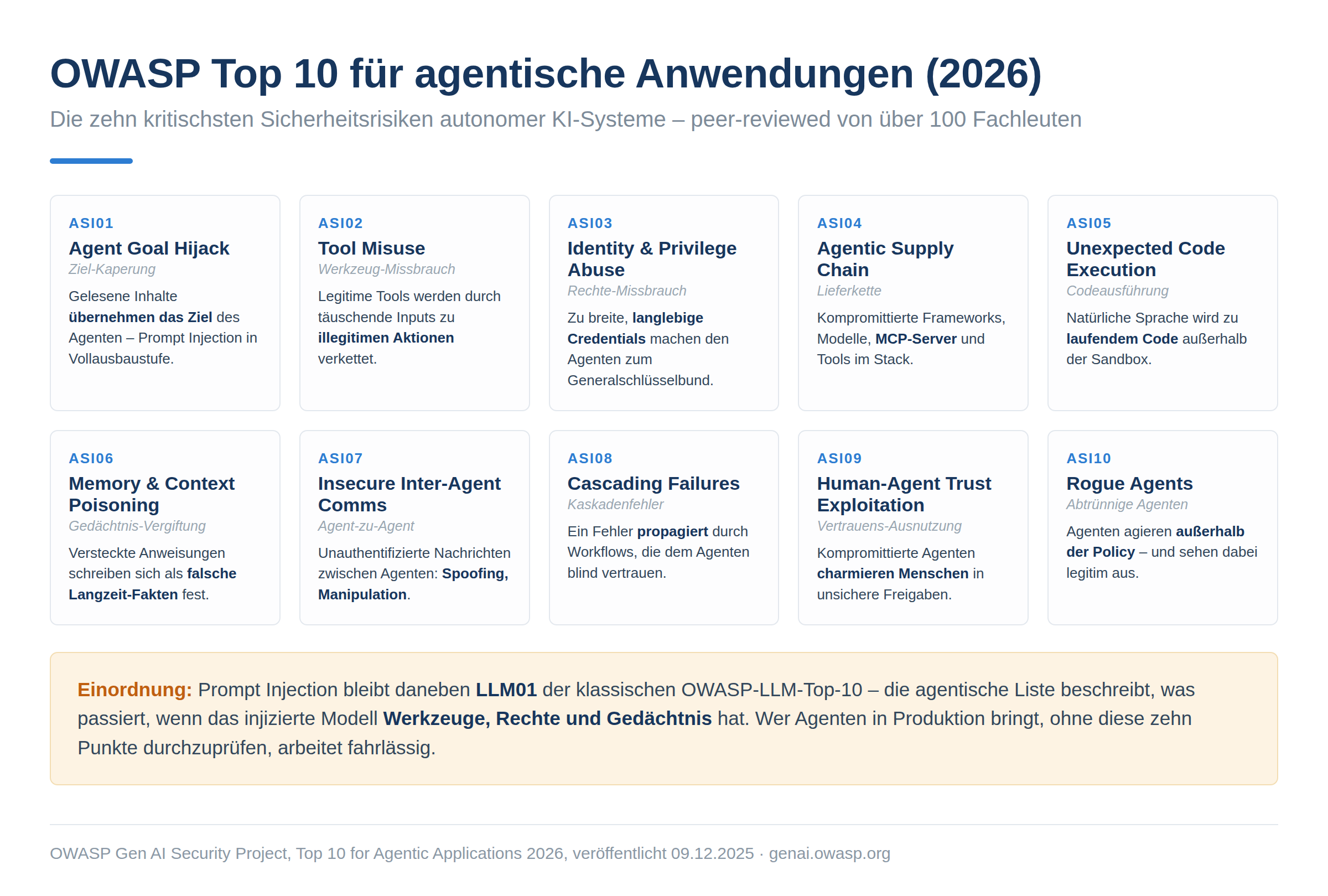
I’ll pull out the clusters that really hurt in practice. This is the version that spares you the incident report later.
A. GOAL HIJACK: THE AGENT KEEPS WORKING — JUST NOT FOR YOU ANYMORE (ASI01)
This is prompt injection in its agentic full build-out. The attacker plants commands exactly where your agent reads anyway. In an email. In a ticket. In a calendar entry. In a README on GitHub. In white text on a white background inside a Word document. In the metadata of an image.
Remember: the invisible ink of the Three Investigators …
And yes, this is by now so banal that even lecturers use it as an AI trap. In 2026 the historian Dr. Jason Gibson (Alcorn State University) hid invisible, white-formatted text in a midterm assignment, with a simple instruction. Include the word “Madagascar” in the answer. Whoever bluntly copied the assignment into an AI system swallowed the bait. Result. In 32 of 35 submissions “Madagascar” showed up. Well, that’s us humans — as a misanthrope, I’m surprised it wasn’t 35 out of 35. (today.com - last visit: 2026-08-22 - 19:47)
With the agent it’s the same mechanism: the agent reads, “understands” and from then on pursues the attacker’s goal while still looking busy for you.
The less humorous classic here is EchoLeak (CVE-2025-32711, CVSS 9.3): a crafted email to a mailbox with Microsoft 365 Copilot could get Copilot, via indirect prompt injection, to disclose internal data from sources like OneDrive and SharePoint to the outside. The perfidious part: zero-click. The user had to click nothing, confirm nothing, not even open the mail. It was enough for Copilot to pull the mail in as context during a later, perfectly harmless user query. Microsoft closed the hole server-side in June 2025; there are no indications of exploitation in the wild. The blueprint has been lying around openly ever since anyway.
(Sources: NVD ; MSRC ; Sentra analysis - last visit: 2026-08-22 - 17:41)
And whoever thinks this only hits office copilots: in July 2025 a destructive instruction was smuggled into the Amazon Q Developer extension for VS Code via a pull request, roughly with the goal of deleting local files and cloud resources. The compromised extension was shipped as version 1.84.0 through the marketplace before AWS removed it, revoked credentials and released version 1.85. According to AWS no customer resources were affected; the incident nonetheless remains a clean piece of evidence for how a manipulated AI supply chain can reach right into regularly shipped developer tooling.
(Sources: SC Media ; AWS Security Bulletin AWS-2025-015 - last visit: 2026-08-22 - 17:41)
B. PERMISSIONS AND IDENTITY: THE AGENT HAS KEYS IT NEVER HANDS BACK (ASI03)
Agents need access. OAuth tokens, API keys, service accounts. Sure.
In practice it’s not “access”, it’s a damn keyring. And it hangs zip-tied to the agent’s wrist far too often. Too many permissions. Too broad. Valid for too long.
Least privilege? Spare me that crap!
Salesloft/Drift, August 2025, is the object lesson. Attackers grabbed OAuth and refresh tokens from the Drift integration and walked with them into the Salesforce instances of over 700 companies. Cloudflare, Zscaler, Palo Alto Networks — of all people, the ones who print “security” on their slides. Google Threat Intelligence / Mandiant tracked the activity as UNC6395; AppOmni categorizes the case as a SaaS supply chain and OAuth integration risk.
(Sources: Google GTIG ; AppOmni ; The Hacker News - last visit: 2026-08-22 - 17:51)
What matters is what didn’t happen. No LLM was “jailbroken”. Nobody needed prompt injection. The attacker simply stole a machine identity, because we pretend a bot account is somehow worth less than a human one.
The tokens were broadly authorized, long-lived and barely monitored. Google later even advised treating all authentication tokens stored in or connected to Drift as potentially compromised; Salesforce removed Drift from the AppExchange and Salesloft/Salesforce revoked tokens.
(Sources: Google GTIG ; SecurityWeek - last visit: 2026-08-22 - 17:51)
Like a master key hanging next to the bed of the sleeping intern. Whoever then acts surprised that it gets taken — the key, not the intern — should have a very long think about themselves. Or better yet: go see a locksmith.
C. MEMORY AND DATA: POISONED MEMORIES (ASI06 + DATA POISONING)
Agents with long-term memory or a RAG connection have a second, nastier injection surface. Not the prompt, the “now” so to speak.
But what stays behind.
More precisely: the agent “eats” a crafted document. Inside it doesn’t say openly “ignore your rules”, but an instruction that looks like content. If your system automatically turns that into a memory, a user preference, a summary or a knowledge-base chunk, the damage is no longer only in the current prompt. Then the manipulation sits persistently in your memory or RAG layer. With vector search, the “instruction” isn’t magically understood; a semantically similar chunk gets pulled back into the context. But that’s exactly what’s enough. As soon as that poisoned chunk later wanders back into the prompt because of similarity, keyword, user profile or workflow context, the old foreign instruction is sitting at the table again.
That’s no longer pickpocketing. That’s a mole.
With the RAG corpus it’s the same trick. Whoever gets to write into your knowledge base rebuilds your agent. You call it a knowledge base, the attacker calls it a remote control.
Evil in, puppet out.
Steered by the evil puppet master.
D. SUPPLY CHAIN: YOUR AGENT IS MADE OF SOMEONE ELSE’S CODE (ASI04)
Frameworks, models, tools, MCP servers. The typical agent stack today is clicked-together internet Lego. And yes, MCP is real progress. I like the standard. It makes tool integration cleaner.
Only, unfortunately, it also makes it more convenient. And convenience is what supply chain attacks have loved for years.
An MCP server is, in the end, someone else’s code with tool power. And its tool descriptions land directly in your context window. Not as a pretty README for humans, but as text feed for the model. That’s exactly where tool poisoning sets in. You don’t see the instruction, the model very much does.
September 2025 was a perfect object lesson for this. A malicious npm package called postmark-mcp posed as a Postmark MCP server. Postmark itself made clear: this was not an official Postmark tool and Postmark had nothing to do with the package. The attacker built up trust over 15 versions and then, in version 1.0.16, inserted a backdoor that secretly copied outgoing emails via BCC to an external server. Koi Security and Snyk name among the IOCs, respectively, phan@giftshop[.]club and the domain giftshop[.]club; The Hacker News reports a total of 1,643 downloads before the package was removed. The actual attack was ridiculously small. One line.
(Sources: Postmark ; Koi Security ; Snyk ; The Hacker News - last visit: 2026-08-22 - 17:59)
And whoever yawns now at “npm package with a backdoor”, because that’s been our daily bread for 10 years. Exactly. That’s precisely why it’s so dangerous.
The agent world takes over the classic supply chain problems one-to-one. It just adds one new, especially nasty layer on top. Even the description of a tool can already be the attack.
E. MULTI-AGENT: ERRORS WITH AN AVALANCHE EFFECT (ASI07, ASI08)
As soon as agents dispatch other agents, you build yourself communication paths that hardly anyone authenticates cleanly and practically nobody really monitors. A single compromised node is enough. It pushes garbage over, the others swallow it because “it says it’s from a colleague”, and in the end the whole workflow tips over. I say it to clients often: most of what gets presented all slicked-up as a multi-agent system at conferences would be more stable, cheaper, more maintainable as a simple workflow with a few LLM steps.
And yes, more secure with it.
Brutal analogy: fewer people on the streets, fewer people who can end up in jail.
Before anyone twitches with dictatorship phantom pain:
From my experience-saturated misanthropic baseline follows no plea for authoritarian order, purge fantasies or other exclusion-zone crap. The very existence of those is part of the reason for my stance.
It only means: fewer actors, fewer error sources.
F. AND THEN THERE’S THE OTHER SIDE. AI AS ATTACKER
Just so the picture is complete. The other side now has agents too. And no, this isn’t the next vendor fairground with a security logo and a lot of smoke.
In November 2025 Anthropic documented the first properly, publicly described AI-orchestrated espionage campaign, GTG-1002, attributed to a Chinese state-backed group. What sticks isn’t the flag, it’s the pattern. Claude Code gets pushed via role-play jailbreak into a “pentester” mode, the attack is chopped into small, inconspicuous morsels, and then the tool does exactly what it was built for. Reconnaissance. Finding vulnerabilities. Building exploit snippets. Collecting credentials. Pulling out data. And as a bonus it hands you the loot report print-ready.
Roughly 30 targets. 80 to 90 percent of the campaign work AI-assisted. Humans only at the nodes where it really hurts. Sure, there’s theater in reports like this too. Some CEO crocodile tear is marketing with a “threat” sticker on it.
Still, the hard core remains. This is an attack vector in its own right.
(Sources: Anthropic ; MITRE ATT&CK C0062 , last visit 2026-08-22 18:06)
AND YOU DON’T EVEN NEED A NATION STATE BEHIND YOU
With the Anthropic case there’s this convenient catch that many people cling to. A frontier model had to be tricked first. Role-play. Salami tactics. Effort. Sounds like professionals with a budget.
Forget that. Really.
Victor Klaue sat down and measured, instead of claiming (see: https://lnkd.in/p/edb7P73v)
That’s exactly why I’m quoting this here and not some thought-leader post with 5 hashtags and zero findings. He ran an official model against its “abliterated” variant, same base, just without the built-in refusal. Freely downloadable. No jailbreak needed, no persuasion, no role-play. The brake is simply gone.
AgentHarm, 176 harmful tasks. The official model refuses 132 times. The abliterated version refuses not once. And that’s not the “polite zero” where it pretends to help and then spits out garbage. It executes. Often it works.
CyBench, hard mode, no internet. The model has to figure out on its own how to crack security challenges. 18 of 39 professional CTF tasks solved. On one of them, human professional teams sat in competition for nearly 25 hours. The model was done after 53 minutes.
And because Victor works cleanly, he also says where it falls down. On many tasks the thing goes in circles. Thinks. Calls tools. Reaches no end. Never submits. Reasoning loops, a known problem in this model family.
His closing question is the right one. Are local LLMs becoming a security risk?
My answer is uncomfortable, but practical. For threat modeling this was settled long ago. It doesn’t matter whether the thing loops in half the cases. The attacker doesn’t have to be efficient. The attacker has to get through once. You, on the other hand, have to hold every single time. This asymmetry is as old as IT security. What’s new is only that the costs on the attacker’s side are dropping toward zero right now. Compute is cheap. Talent isn’t.
AGENT ATTACKS AGENT
And exactly this vector is now tipping into the agent zoo we’re currently building. It’s no longer just “human attacks agent”. It becomes “agent attacks agent”. Remote agents push instructions into running A2A sessions, exploit soft trust edges and smuggle in tasks or artifacts that first look like work and later like an incident.
Unit 42 calls this “Agent Session Smuggling”. A malicious remote agent abuses an existing Agent2Agent communication and plants covert instructions with the victim agent. In the proofs it was about data exfiltration and tool execution without authorization. That’s not the flagpole. That’s the tent peg.
And if you think this stays in A2A games. Runtime cases like Sysdig’s agentic container escape show that LLM-driven attackers don’t just spit out nice phishing mails, but try escape primitives, Kubernetes service-account tokens and secret stores at machine rhythm. Hype and vendor drum are in the mix, yes.
The shift underneath is real. Attacks get faster. More adaptive. And they wander exactly to where you’re currently smearing your orchestration and agent glue.
(Sources: Unit 42 ; Sysdig , last visit 2026-08-22 18:06)
GERMANY’S C’T JUST DISSECTED THIS. AND I’M SAYING IT PLAINLY. GO READ IT!
At this point I’m happy to point to “someone else’s work”, because it’s simply good:
c’t 18/2026 of 21 August 2026 — Europe’s largest IT magazine — made AI security its cover story: “KI bringt IT-Security ins Schleudern – Wie Angreifer und Verteidiger aufrüsten” (AI is sending IT security into a skid – how attackers and defenders are arming up).
On pages 16 and 17 my colleagues there assemble what I can only sketch here. The Mexico case, in which a single hacker — in the editors’ own assessment “at best of average talent” — used two LLMs to take over several hundred government servers in about two weeks, work that would otherwise have occupied a team of specialists for months. The Toronto worm, which installed its own LLM on captured GPU systems and thus literally brought its own brain along. And the first fully LLM-planned ransomware attack.
And then there’s this sentence, more precise than I would probably have managed.
“But it shows, quite clearly, where this is heading. Within just a few months, even below-average attackers will operate, with the help of AI, at a level that defenders and their IT are not prepared for. That will be the new normal, and everyone should be preparing for it now.”
— c’t Magazin für Computertechnik, issue 18/2026 of 21 August 2026, p. 17 (translated from the German)
That closes the circle back to Victor’s measurement. “Below-average attackers”. Exactly the group for whom a freely downloadable model without a brake makes the difference.
The nation state with the frontier model isn’t the real story. The real story is that the barrier to entry is rotting away.
Hence the reading recommendation, with nothing in it for me, no affiliate nonsense.
Buy yourself the issue. c’t covers the topic across far more pages and with more research depth than a blog post could ever manage.
I don’t steal other people’s research. I point to it and say where it came from.
And in the same breath my colleagues there deliver the part that gives hope. “Hoffnungsschimmer und Trugschlüsse” — glimmers of hope and fallacies. The core. AI does not, so far at least, invent new classes of bugs. The vulnerability types it finds are ones you’ve known for ages. Buffer overflows. Logic errors. Misconfigurations. And the number of existing holes is finite. What defenders find and close with AI, an attacker can no longer exploit afterwards.
That is exactly why the problem is solvable.
If attacks get faster, cheaper and more numerous while the building blocks stay the same old ones, you don’t need a new magic formula. You need what we’ve known for decades. Only finally built. Not just claimed on slides.
PART 2: THE EXAMINATION SCHEME OF THE DEFENSE
So. Enough complaining, now comes the constructive part.
I’ll build it for you as an examination scheme. Yes, occupational disease. But it works. That way you forget nothing. And forgetting can get damn expensive in law and in IT security.
And there are examination-scheme parallels between the two worlds:
An attack only works when several preconditions sit at the same time. Cumulatively. Like a legal offense.
Your defense therefore has exactly one job. You take out at least one of these preconditions. Any of them.
And suddenly the thing is no longer satisfiable.
You don’t have to memorize and parry every single attack. You build your AI software so that the attacker fails at the setup, not at your reaction time.
A. FIRST EXAMINATION: THE LETHAL TRIFECTA — THREE OFFENSE ELEMENTS
Simon Willison nailed the basic pattern on June 16, 2025 and christened it “the lethal trifecta”: access to private data, exposure to untrusted content, and the ability to communicate externally. An agent becomes dangerously flammable when these three elements come together.
(Source: Simon Willison - last visit: 2026-08-22 - 18:13)
- Access to private data (mailbox, CRM, file store, database)
- Exposure to untrusted content (anything third parties can write: mails, web pages, tickets, documents)
- The ability to communicate externally (send mail, HTTP requests, write access)
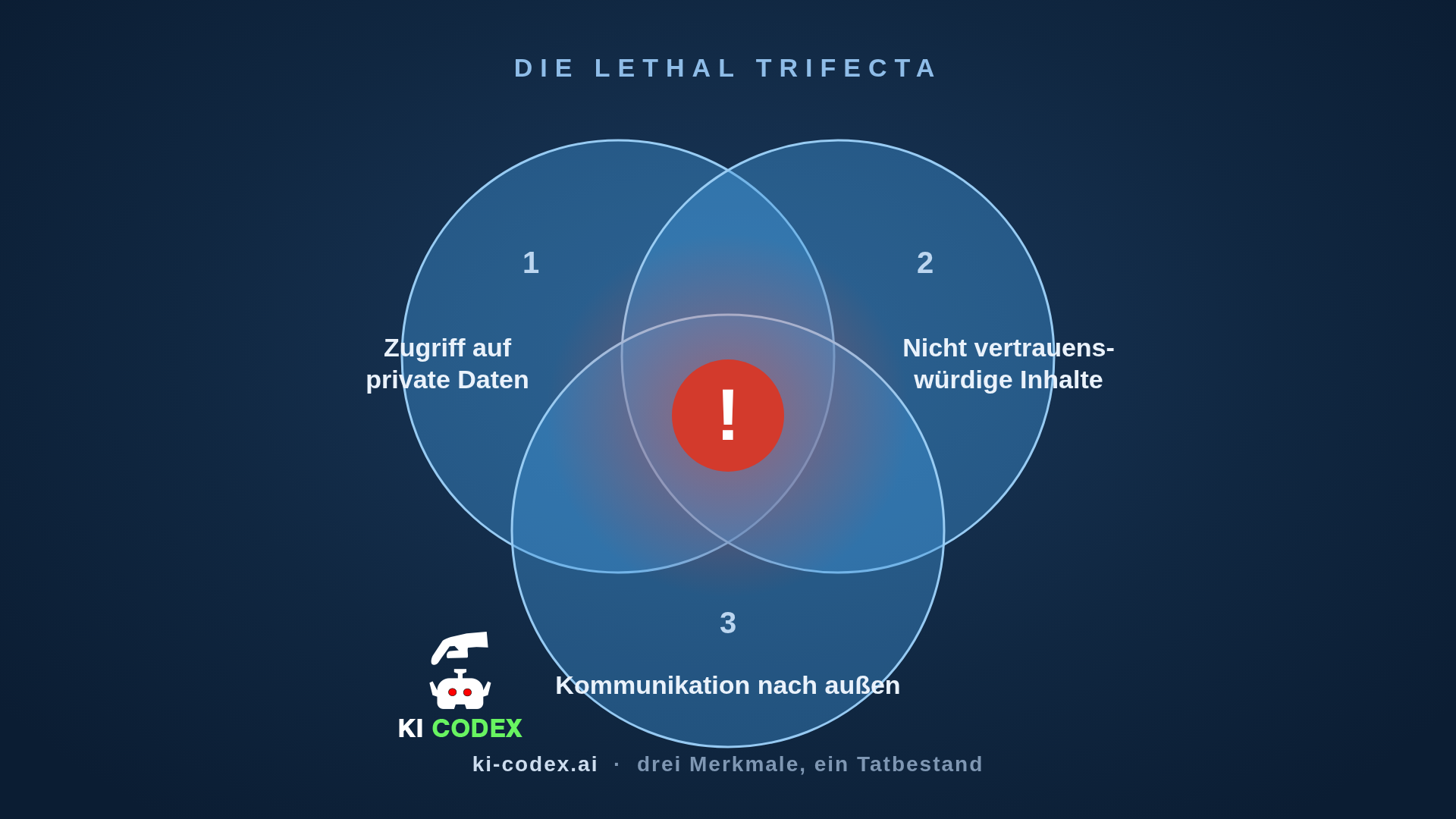
Element 1 alone is boring. A search index. Nothing more.
Element 1 plus 2 is already nasty. The agent reads filth, collects internals. It just doesn’t get out yet.
Hell begins when 3 joins in. Then the instruction lies in the untrusted content (element 2), the agent pulls your private data over (element 1) and dutifully sends it outward (element 3). EchoLeak was exactly this game. Again and again.
You run this subsumption for every agent you build or buy. Per tool set. Per session. Before guardrails, before filters, before any “AI security” cosmetics.
If all three elements are satisfied, you don’t debate configuration.
You pull the brake.
B. SECOND EXAMINATION: META’S RULE OF TWO — THE ARCHITECTURAL DECISION
On October 31, 2025 Meta built a surprisingly honest design rule out of Willison’s trifecta: the “Agents Rule of Two”. The core is simple: as long as prompt injection cannot be reliably detected and defended against, an agent may have at most two of three properties at the same time within one session:
[A] process untrusted input,
[B] have access to sensitive systems or private data,
[C] change state or communicate externally.
Two of them are manageable. All three together close the attack chain: the foreign input supplies the instruction, the data access supplies the loot, the communication or write capability supplies the drain. It’s exactly at this point that you need human approval, a hard context cut, or some other technical interruption of the chain.
(Source: Meta AI - last visit: 2026-08-22 - 18:16)
Why I like this rule is simple: it’s an admission. Meta isn’t some guardrail startup with a pretty deck, but one of the largest deployments of all. And Meta is saying, without putting it that harshly: we currently can’t reliably detect prompt injection. So we don’t try to magically predict the fire. We put in firebreaks. Not “it will never burn”, but: if it burns, the whole building must not go up at once.
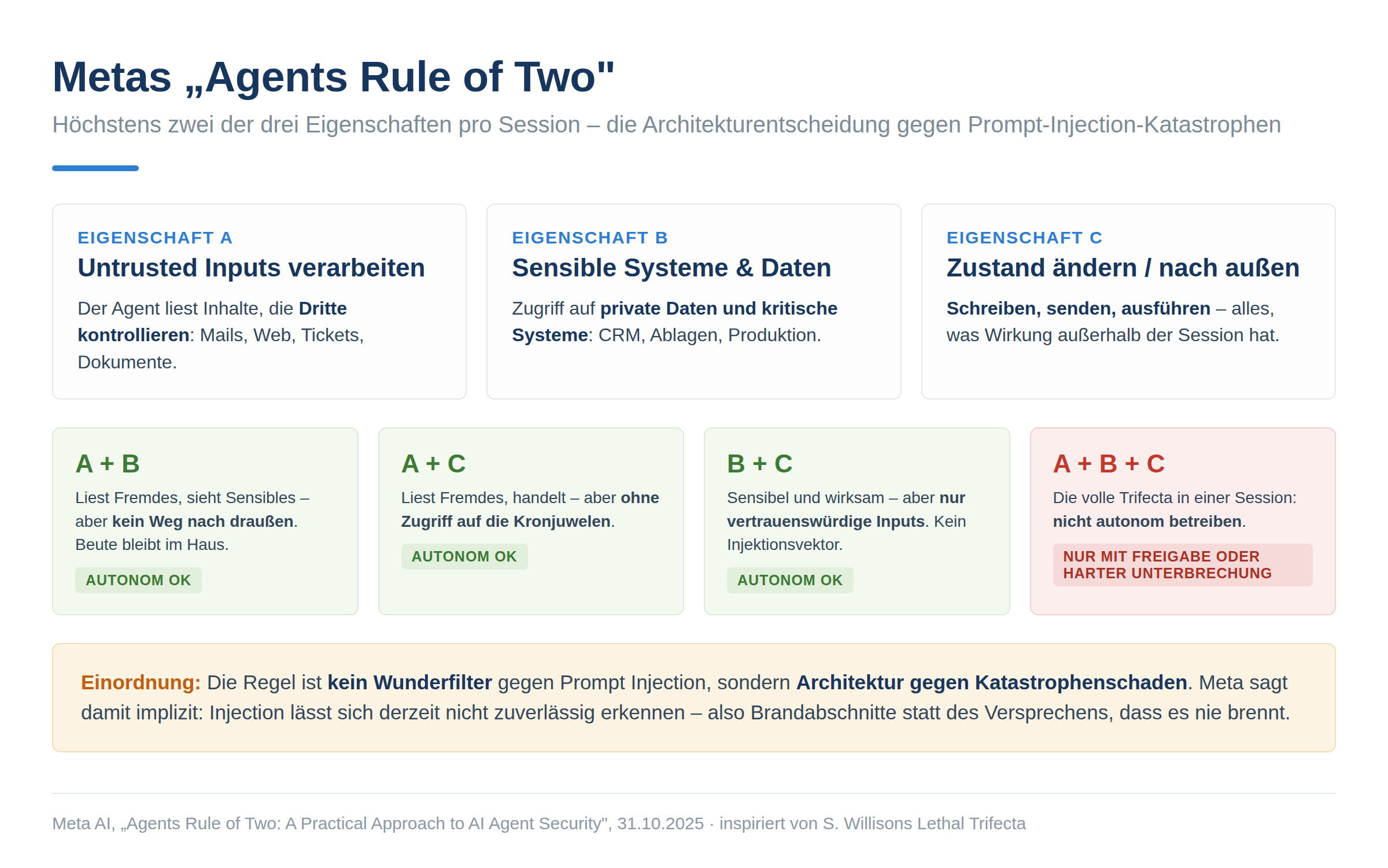
In practice that means: you decompose your use case along these three properties.
The agent that reads foreign mail ([A]) must not at the same time write outward ([C]) with full CRM access ([B]).
Between these roles lies a clean cut: structured handover, schema validation, restricted recipients, egress control, and in case of doubt a human looking at the raw action instead of the pretty agent summary. Research approaches like Google DeepMind’s CaMeL formalize exactly this idea: untrusted content may be processed, but the actions derived from it run through a controlled layer that only lets pre-approved things through.
And yes, that costs convenience.
Security versus convenience is the oldest trade-off in the industry.
Whoever sells you an agent that reads everything, reaches everywhere, is allowed everything and supposedly stays “secure through AI guardrails” isn’t selling you a security concept. He’s selling you a perpetual motion machine with a SOC 2 sticker.
C. THIRD EXAMINATION: THE FIVE DEFENSE LAYERS
Onwards.
Five layers. From inside out. None is decoration. None replaces another. Defense in depth has existed for ages. Agentic AI is just a new reason to finally take it seriously.
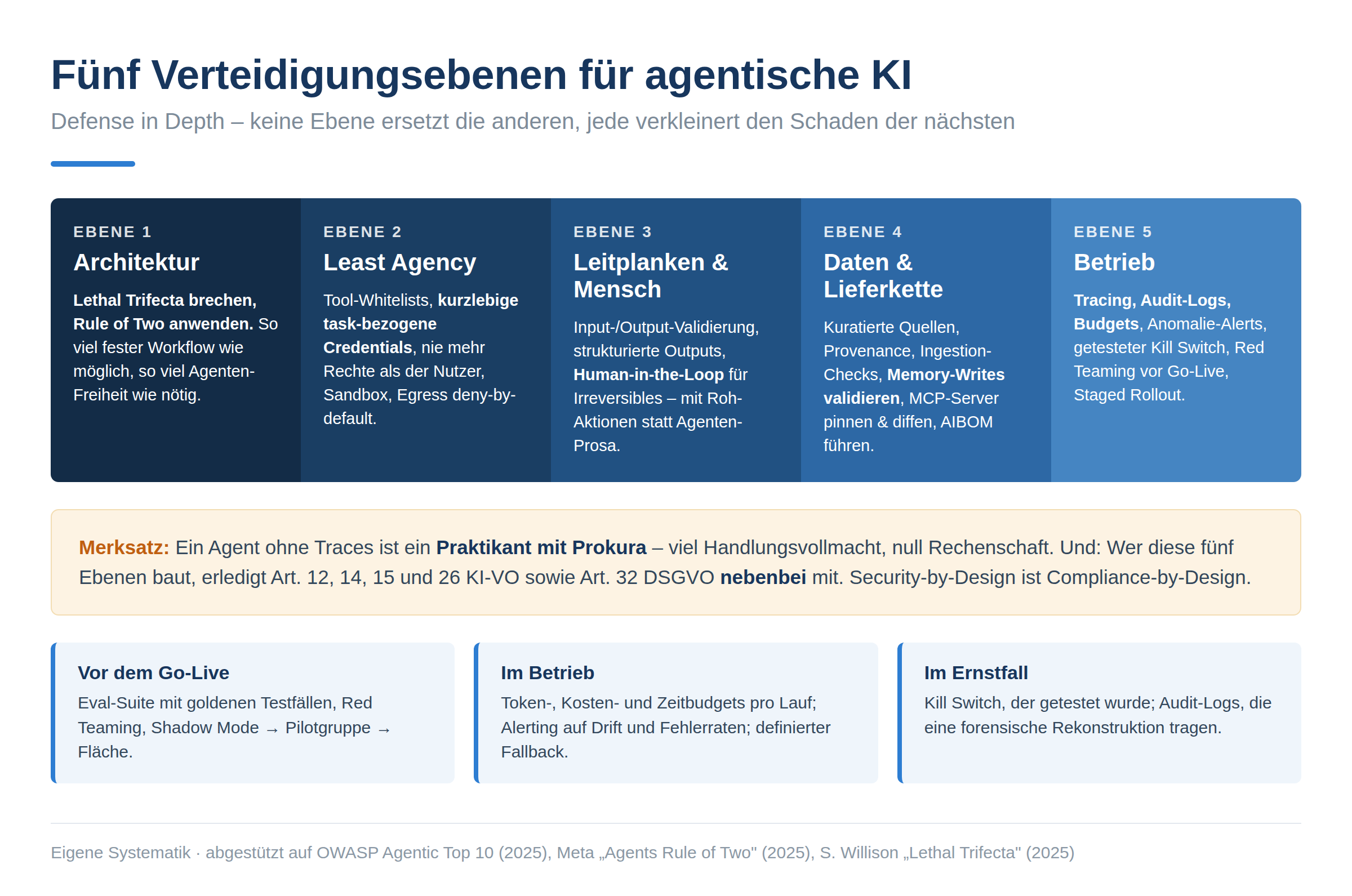
Layer 1 — Architecture. You know this already from the trifecta and the Rule of Two. Here comes my architect’s rule on top, the one I’d most like to staple to teams’ foreheads. As much fixed workflow as possible. As much agent freedom as necessary. Everything that can be deterministic becomes deterministic. The model shouldn’t “creatively” guess whether it’s now wiring money or deleting data. It should only decide where deciding is actually its job. Less surface. Less randomness.
Layer 2 — Least Agency. This is least privilege, just without the excuse “it’s only a bot”. The agent never gets more permissions than the human it’s currently working for. Tools run through a whitelist. Credentials are short-lived and task-scoped, not the eternal service account with an admin role. Whoever still has tokens with week-long lifetimes lying around after Salesloft/Drift didn’t hear the shot. You treat tool parameters like user input, because that’s exactly what they are, only run once through an LLM. Code execution belongs in a sandbox. Network egress belongs on deny-by-default. An agent that knows only three permitted endpoints exfiltrates like a fish out of water.
Layer 3 — Guardrails and human. Input filters and output checks are okay. As a hurdle. Not as salvation. Where you can, you force structured, schema-validated outputs. Free text is pretty, but free text is also the on-ramp to catastrophe. And for irreversible actions you need human approval. Deleting. Paying. Sending. Deploying. Just please don’t build the classic fake approval dialog. OWASP calls that ASI09. If the human only sees the friendly summary, the human isn’t a control, but decoration. A compromised agent writes you charming summaries. Show the raw action. Which API call, which parameters, which recipient. Otherwise you click the attacker’s “approval” for him yourself.
Layer 4 — Data and supply chain. Curated sources with provenance instead of “let’s just index everything”. Validation happens in the ingestion pipeline, not first in the dashboard when it’s already burning. Very important, this point! Memory writes are security-relevant operations. You check what gets persisted. You keep context volatile in case of doubt. You treat MCP servers and tools like any dependency. Pin versions. Check provenance. Diff tool descriptions on updates. The description is part of your prompt. A changed description is a changed prompt. And yes, keep a bill of materials, an AIBOM, so that at the next Postmark case you know in minutes whether you’re affected, instead of doing Slack archaeology for a week.
Layer 5 — Operations.
MEGA-IMPORTANT!
An agent without traces is an intern with power of attorney.
Lots of authority, zero accountability. So you need tracing of every step. Tool calls, model answers, decisions, the whole circus, the full orchestra, e.g. with OpenTelemetry.
Plus audit logs that actually carry a forensic reconstruction. Budgets for loops, tokens, cost and time. Otherwise the thing spins expensively in circles in the failure case and calls it “reasoning”. Alerting on anomalies. If the agent suddenly fires 400 requests at a new domain at three in the morning, that’s not a feature. Then it’s an incident.
Plus a kill switch that not only exists but is tested.
Red teaming before go-live — inject your own agents before strangers do. Play the chaos monkey!
And roll it out in stages. Shadow mode, pilot group, full rollout.
The demo circus ends at the point where production begins.
Best you hire professionals for that:
me!
Was that a proper Western-style CTA?
Lucky Luke couldn’t have fired that elegant, discreet shot from the hip any better.
THE BY-CATCH: WHY YOU KNOCK OUT YOUR COMPLIANCE ALONG THE WAY
A promise is a promise. Compliance stays by-catch here. But unfortunately it’s the by-catch over which people later lose their budgets and their nerves.
If you really build these five layers, you’re already handing the AI Act most of the ammunition. Logging under Art. 12. Human oversight under Art. 14. And that whole “accuracy, robustness, cybersecurity” number from Art. 15 that many only take seriously once the auditor is in the calendar. Deployer diligence under Art. 26 falls off the truck along with it.
On the GDPR side it’s the same film. Art. 32 is nothing mystical, it’s simply the question of whether you build your systems so that they survive an attack and you can still explain afterward what happened.
NIS2 comes on top if you deliver into critical sectors. The Cyber Resilience Act is lurking behind the next product roadmap anyway. And yes, the Digital Omnibus pushed high-risk obligations back in time. Whoever reads that as an invitation to postpone architecture is currently building a later, very expensive fire.
The point is banal and therefore so unpleasant. Security and compliance want the same artifacts in the end. Traces, permission concept, approvals, data provenance, emergency stop. If you get that right once cleanly, you get two audits for the price of one. You just have to stop pretending these are two different worlds.
CONCLUSION
Agentic AI is attackable because the base architecture celebrates the same old mistake we’ve regretted for decades. Instructions and data in the same channel. An open flank for which there is no patch.
The evidence is on the table. EchoLeak as the blueprint for zero-click exfiltration. Amazon Q as a reminder that “supply chain” doesn’t just mean libraries, but also smuggled-in instructions. Salesloft/Drift as the object lesson that machine identities have long been the crown jewels. GTG-1002 as the ugly proof that the other side no longer has only humans.
No, don’t worry: you don’t have to torch the agent zoo because of this. You have to build it like a system that gets attacked. Check the trifecta. Take the Rule of Two as a design boundary. Really pull through the five layers. Not as a guardrail fairy tale, but as architecture that withstands errors, produces logs, and in case of doubt puts the plug into your hand.
This article is not legal advice in an individual case and does not replace advice from a lawyer. It’s meant to help you understand the security and regulatory situation of agentic systems and to ask the right questions in practice.
When it comes to the concrete implementation — that is, the connection of IT & law (security-by-design, compliance-by-design, documentation, audit architecture) — you can hire me for it.
That was CTA no. 2.
Not to be confused with GTA …